
ESET researchers have discovered two as-yet undocumented Windows variants of SprySOCKS, a previously Linux-only backdoor reportedly used by FishMonger, the group believed to be operated by a Chinese contractor named I‑SOON. While we initially discovered the malware samples on VirusTotal, ESET telemetry shows real activity between 2023 and 2024, with several victims in Honduras, Taiwan, Thailand, and Pakistan, targeting mostly government organizations.
The Windows variants discovered are internally marked as WIN_DRV and WIN_PLUS. Both come with a hardcoded C&C configuration and support communication over TCP, UDP, and WebSocket protocols. The core backdoor functionality for both includes support for over 30 C&C commands, covering various functionalities including system information collection, process enumeration, as well as service management and file management functions such as listing, creating, deleting, and transferring files.
In addition to the core backdoor functionality, the WIN_DRV version utilizes kernel drivers to hide the malware’s network connections, processes, files, and registry keys, and enables TCP traffic diversion allowing the malware operators to send commands to the backdoor through a random TCP port on the victim’s device without exposing the backdoor's real listening port in the network traffic.
Based on ESET telemetry, there are limited indications that some SprySOCKS attack scenarios may involve a UEFI bootkit component, possibly exploiting CVE‑2023‑24932.
The analysis provided in this report leads us to attribute these new, Windows variants to FishMonger with high confidence.
Key points of this blogpost:
- We discovered two previously undocumented Windows variants of FishMonger’s SprySOCKS backdoor.
- ESET telemetry shows activity between 2023 and 2024, primarily targeting government organizations in Honduras, Taiwan, Thailand, and Pakistan.
- Both Windows variants support communication over TCP, UDP, and WebSocket protocols, and implement over 30 commands.
- The WIN_DRV variant creates a stealthy passive TCP backdoor, relying on a kernel driver to redirect traffic to the backdoor’s hidden TCP port whenever specially crafted data is detected inside a received TCP packet.
FishMonger profile
FishMonger – believed to be operated by a Chinese contractor named I‑SOON (see our Q4 2023–Q1 2024 APT Activity Report) – is a cyberespionage group that falls under the Winnti Group umbrella and is most likely operating out of China, from the city of Chengdu. It is also known as Earth Lusca, TAG-22, Aquatic Panda, or Red Dev 10. We published an analysis of FishMonger in early 2020 when it heavily targeted universities in Hong Kong during the civic protests that started in June 2019. The group is also known to operate watering-hole attacks, as reported by Trend Micro. FishMonger’s toolset includes ShadowPad, Spyder, Cobalt Strike, FunnySwitch, SprySOCKS, and the BIOPASS RAT.
Technical analysis
In this section, we provide a technical analysis of these new, Windows variants of FishMonger’s SprySOCKS backdoor.
The archive that led us to this discovery was uploaded to VirusTotal in April 2024 under the name klelam00007.zip; its contents are shown in Figure 1.
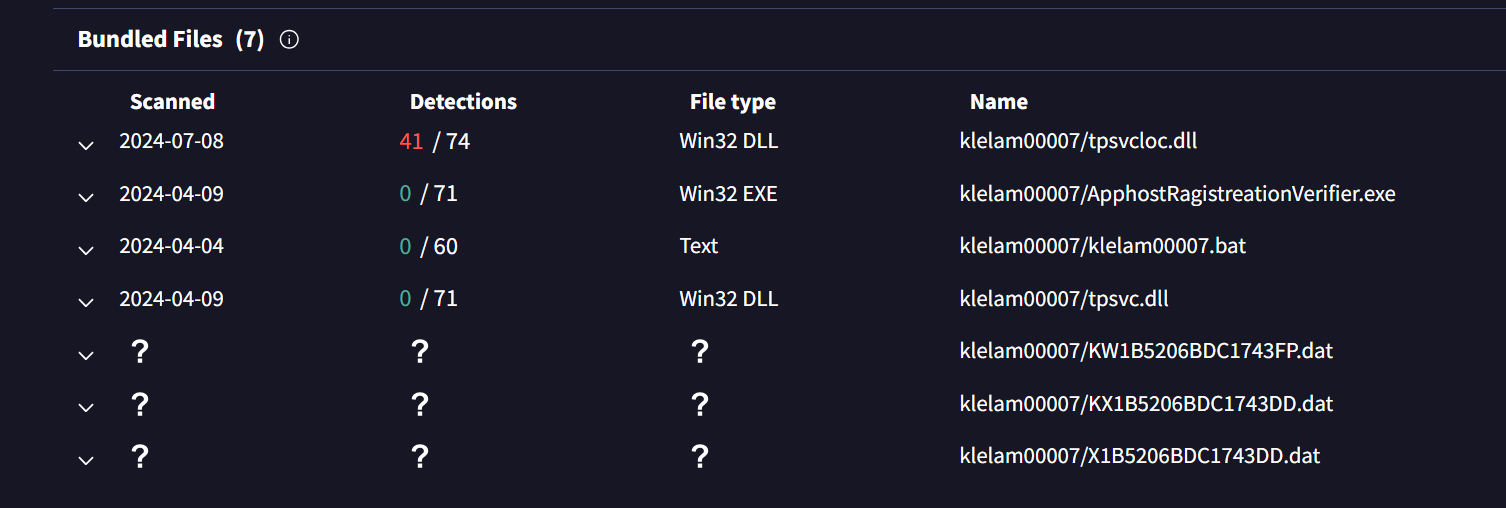
This archive contains various files, including legitimate ones used to host DLL side-loading, and three suspicious-looking, encrypted files with .dat extensions. Our subsequent analysis revealed that these encrypted files contain a new, previously undocumented Windows variant of FishMonger’s SprySOCKS backdoor, labeled WIN_DRV by its developers. Further investigation revealed an additional backdoor version, labeled WIN_PLUS, in ESET Telemetry.
Initial access
FishMonger has been known for targeting the public-facing servers of its victims, often exploiting server-based N-day vulnerabilities, to gain initial access. While we were not able to confirm the exact way FishMonger got into its victims’ systems in this campaign, the presence of a server operating system on some of the victim devices along with FishMonger’s typical modus operandi suggest that the attackers may well have got in through misconfigured or unpatched public-facing applications.
SprySOCKS for Windows
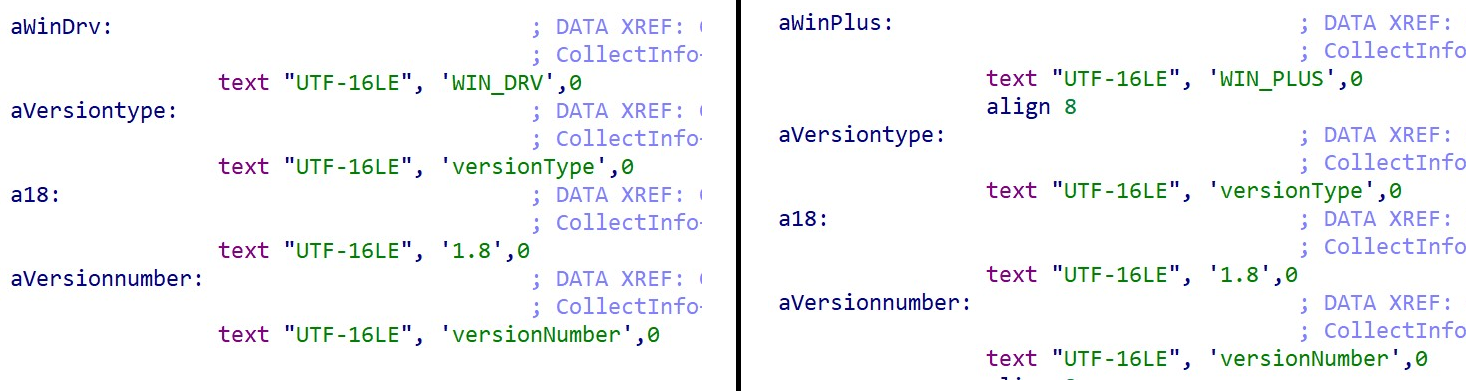
In September 2023, Trend Micro published a report about a new FishMonger Linux backdoor that its analysts named SprySOCKS. The code of the backdoor is based on an open-source Windows remote access trojan (RAT) named Trochilus, and shares several common characteristics with the RedLeaves backdoor; nevertheless, it was extended and modified enough to be considered a new backdoor. In this report, we analyze two as yet undisclosed Windows variants of v1.8 of SprySOCKS:
- One has been named WIN_DRV by its developers and uses a kernel driver for advanced stealth.
- Another, without the driver, is named WIN_PLUS.
As shown in Figure 2, the backdoor version type and number are hardcoded in the binary.
The vast majority of artifacts and functionality present in the Linux version of the SprySOCKS backdoor introduced in Trend Micro’s report can also be found in the newly discovered Windows SprySOCKS variants described in this report. These include:
- the same C&C message format,
- very similar C&C commands (plus some additional ones),
- the same encryption keys and algorithms, and
- the use of the same statically linked networking library (HP-Socket).
For both of these new SprySOCKS variants, the core backdoor functionality involving C&C communication and available commands is very similar. The most notable differences can be spotted in the way the final backdoor is loaded, in the improved stealthiness, and in the component names and paths used.
In the following subsections, we first analyze components involved in the execution chain of individual SprySOCKS variants, and then we describe the backdoor component, which is mostly the same for both variants.
WIN_DRV components
In an archive uploaded to VirusTotal, we discovered the WIN_DRV version of SprySOCKS, which comes with an empty C&C configuration. As a result, this version does not actively contact any remote addresses; however, it is still capable of launching a TCP server on a random port on the victim’s device, thus acting as a passive backdoor. Interestingly, the attackers don’t need to know this server’s TCP port number because, as explained later, the RawWNPF driver used by the WIN_DRV version allows silent diversion – to the backdoor itself – of TCP traffic received on any open port (more in the RawWNPF driver section).
As shown in Figure 1, the archive containing the WIN_DRV version of SprySOCKS contains several files:
- klelam00007.bat – a batch script responsible for persisting the backdoor. As shown in Figure 3, it:
○ copies all files from the current working directory into the %SystemRoot%\Fonts directory (to function properly, the batch file needs to be deployed in the same directory as the rest of the files from the archive),
○ creates a scheduled task named ApphostRagistreationVerifier, configured to execute ApphostRagistreationVerifier.exe (which is a legitimate, validly signed executable, renamed by the attackers to mimic the legitimate Microsoft-signed AppHostRegistrationVerifier.exe) with NT AUTHORITY\SYSTEM privileges on every system start. The attackers use the well-known DLL side-loading technique, taking advantage of the way Windows loads DLLs, to load their own malicious DLL (in this case tpsvcloc.dll) by using a legitimate, signed application. To be specific, in this case the attackers use Malware Sideloading via MFC Satellite DLLs technique (note the loc string in the tpsvcloc.dll filename),
- ApphostRagistreationVerifier.exe – a legitimate, ThinPrint’ AutoConnect printer creation service signed executable (SHA‑1: FFC3AA7909D4E72C360D65A1F45260DFFE5C99B7) that loads the tpsvc.dll library,
- tpsvc.dll – a legitimate, signed library that loads the tpsvcloc.dll library,
- tpsvcloc.dll – the SprySOCKS backdoor loader,
- X1B5206BDC1743DD.dat – an encrypted container comprising the SprySOCKS backdoor and copies of the next two files,
- KX1B5206BDC1743DD.dat – DriverLoader, an encrypted kernel driver responsible for loading another kernel driver from KW1B5206BDC1743FP.dat, and
- KW1B5206BDC1743FP.dat – RawWNPF, an encrypted kernel driver responsible for hiding the backdoor’s files and network activity.

Figure 4 depicts the execution chain of the SprySOCKS WIN_DRV variant.
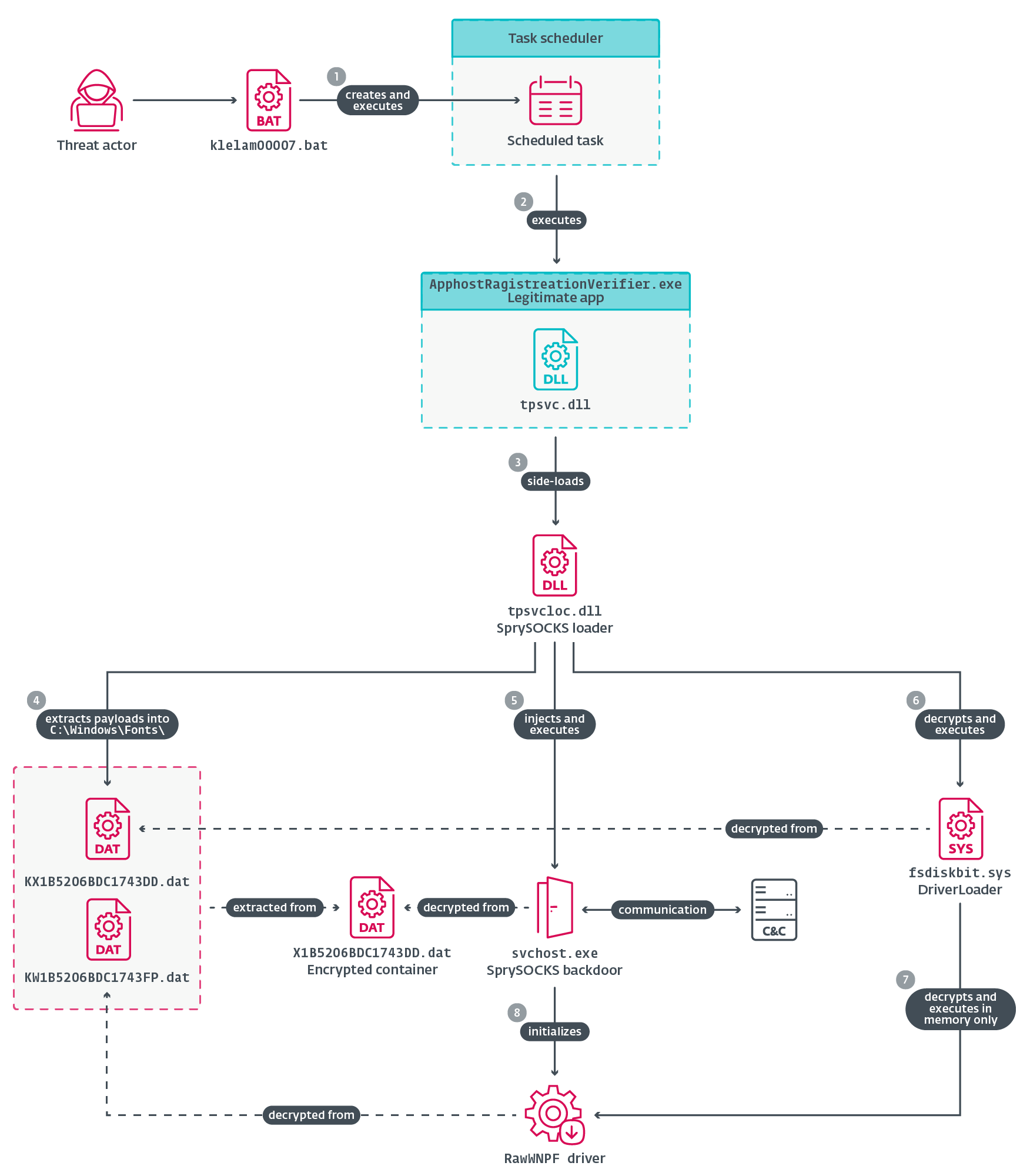
The following three subsections provide technical analyses of the aforementioned components: SprySOCKS loader, DriverLoader driver, and RawWNPF driver.
SprySOCKS loader
The loader starts with initial checks for the presence of a virtual environment and a few security products. It looks for specific libraries (namely: snxhk.dll, SxWrapper.dll, SxIn.dll, SXIn64.dll, and SbieDll.dll) in the loader’s process, and exits if it finds any of them.
As the next step, it verifies whether persistence was set successfully by the klelam00007.bat script, from Figure 3. To do so, it checks whether the current loader’s image was loaded from the %SystemRoot%\Fonts\ directory, and tries to access the %SystemRoot%\Fonts\X1B5206BDC1743DD.dat, %SystemRoot%\Fonts\tpsvc.dll, and %SystemRoot%\Fonts\tpsvcloc.dll files. If it finds that any of these files are not where they are supposed to be, it sets up persistence on its own by:
- copying X1B5206BDC1743DD.dat, tpsvc.dll, tpsvcloc.dll, and ApphostRagistreationVerifier.exe from the current working directory into the %SystemRoot%\Fonts\ directory,
- registering the %SystemRoot%\Fonts\ApphostRagistreationVerifier.exe application as a debugger for vds.exe (a Virtual Disk Service that can be automatically executed on system start) by writing the application’s path into the registry value HKLM\SOFTWARE\Microsoft\Windows NT\CurrentVersion\Image File Execution Options\vds.exe\debugger, and
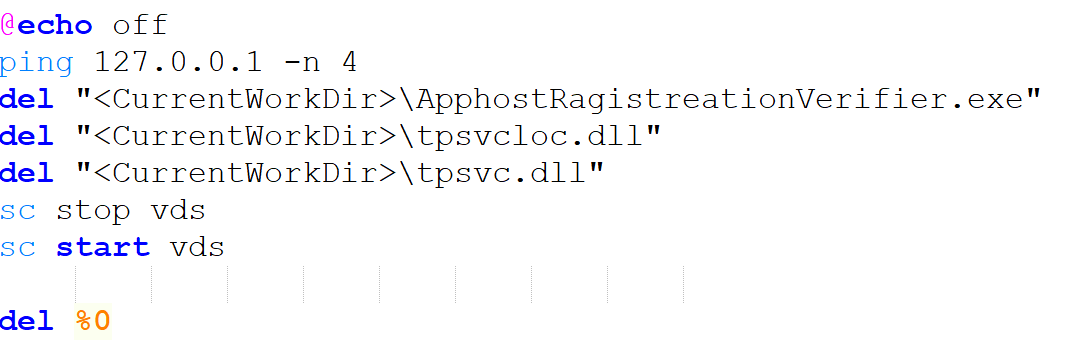
- dropping the affair-build.bat file into the %SystemRoot%\Fonts\ directory and then executing it via cmd.exe. This script, shown in Figure 5, clears traces of this process by removing files from the deployment directory and executing the malware again (now from %SystemRoot%\Fonts\) by restarting the vds service.
When persistence is set, the loader continues with loading payloads from an encrypted container located at %SystemRoot%\Fonts\X1B5206BDC1743DD.dat. The decryption algorithm and key: 128-bit AES in ECB mode with the hardcoded key uXQLESMXGaRMs6BL.
This produces shellcode generated by the DllToShellCode open-source tool. Before executing the shellcode, it extracts the rest of the encrypted payloads from the container into separate files:
- %SystemRoot%\Fonts\KX1B5206BDC1743DD.dat
- %SystemRoot%\Fonts\KW1B5206BDC1743FP.dat
When done, the loader spawns a new svchost.exe process using CreateProcessAsUserW with a token obtained from spoolsv.exe, and injects the backdoor’s shellcode into the process by using the process doppelgänging technique. During the injection process, the shellcode is dropped into a temporary file, using the prefix TH in its filename, within the %TEMP% directory.
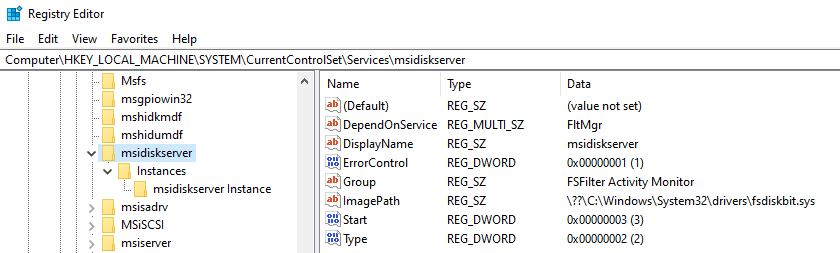
As the last step, the loader proceeds to decrypt and execute DriverLoader, a kernel driver hidden inside the previously dropped KX1B5206BDC1743DD.dat file. DriverLoader is first decrypted, then the decrypted contents are saved to C:\Windows\System32\drivers\fsdiskbit.sys. To execute it, the loader installs this driver as a minifilter driver by manually creating a new service registry key named msidiskserver with an ImagePath value pointing to the dropped driver (as shown in Figure 6) and invokes the NtLoadDriver Windows API function with the registry key as the parameter to load it. If no errors are detected, the loader deletes both the msidiskserver registry key and the fsdiskbit.sys file. After this, the loader is done and exits.
DriverLoader driver
Before jumping to DriverLoader’s functionality, one important note: with the release of Windows Vista, Microsoft introduced driver signature enforcement (DSE), a feature ensuring that only validly signed kernel-mode components are allowed to be executed in the Windows kernel. This means that to execute the fsdiskbit.sys driver (DriverLoader), attackers need to sign it with a trusted certificate.
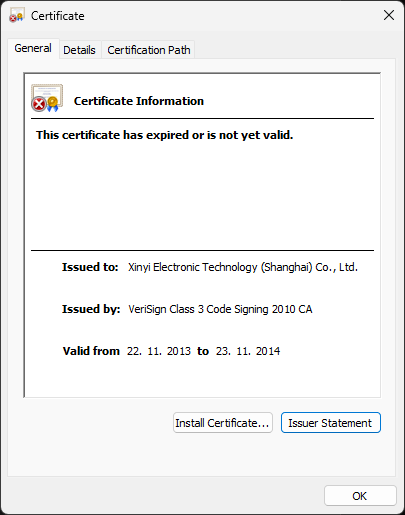
To make the driver work on at least some outdated or misconfigured systems, the attackers used a leaked certificate available on GitHub in the PastDSE project repository, and signed the fsdiskbit.sys driver with it. Information about the certificate used can be found in Figure 7.
Now to the functionality. The purpose of this component is quite straightforward: to load another driver, this time in memory only. First, it reads and decrypts the contents of the C:\Windows\Fonts\KW1B5206BDC1743FP.dat file, previously created by the loader. It uses the same algorithm and key as used by the loader: 128-bit AES in ECB mode with the key uXQLESMXGaRMs6BL. The decrypted data contains a native PE binary (described in the RawWNPF driver section), which is then manually mapped and its entry point executed.
There is the PDB path embedded in the DriverLoader binary:
C:\Users\xdd\Desktop\今天\2023-4-11\2023‑04‑10__注册表驱动加载功能__集成到内测3中-未完成\DriverMemoryLoadDriver\x64\Release\DriverMemoryLoadDriver.pdb
The parts in simplified Chinese machine translate as:
- 今天: Today
- 注册表驱动加载功能__集成到内测3中-未完成: Registry driver loading function__is integrated into internal beta 3-not completed
As we can see in the symbols path, this component seems to have been in development at least since April 2023, which aligns with DriverLoader’s compilation timestamp. Similarly, strings in the path suggest that the project this driver is part of was likely still in development when the driver was compiled.
RawWNPF driver
The RawWNPF driver is the component that makes the WIN_DRV version of the SprySOCKS backdoor much stealthier when compared to the WIN_PLUS variant. It allows hiding the backdoor’s malicious activity on the compromised system, and can be configured by invoking the driver’s custom I/O control codes (IOCTLs). The driver creates a device driver named \Device\RawWNPF; a list of the available IOCTLs, with short descriptions, is shown in Table 1.
Table 1. List of IOCTLs handled by the RawWNPF driver
| IOCTL | Description |
| 0x220200 | Configure the driver to hide active network connections to and from the specified local TCP port. |
| 0x220300 | Unhide the network connections configured with 0x220200. |
| 0x220340 | Insert an entry into the hidden connections list. |
| 0x220344 | Remove an entry from the hidden connections list. |
| 0x220348 | Wipe the whole hidden connections list. |
| 0x22034C | Read the hidden connections list. |
| 0x220350 | Insert a process with a specified PID into the hidden processes list. |
| 0x220354 | Remove a process with a specified PID from the hidden processes list. |
| 0x220358 | Wipe the whole hidden processes list. |
| 0x22035C | Read the hidden processes list. |
| 0x222000 | Initialize the driver’s main functions (hiding network connections, hiding processes, hiding malware components, network filters, persistence protection). After this initialization, other IOCTLs can be used to configure what exactly should be hidden. |
| 0x222004 | Returns two hardcoded DWORD values: 1 and 2. This possibly could be the driver’s version. |
| 0x222008 | Delete the driver’s binary (if it exists). |
Hiding specified processes
The RawWNPF driver can be configured to hide processes based on their process IDs, and a list of hidden processes can be managed by invoking the driver’s IOCTLs 0x220358, 0x22035C, 0x220354, and 0x220350. To hide a process, the driver hooks execution of the NtQuerySystemInformation system call and modifies its output if information about running processes is being retrieved (i.e., if SystemProcessInformation is passed to the SystemInformationClass parameter). If any of the processes retrieved by this API function match a process from the driver’s list of hidden processes, the driver removes this process from the function’s output. The way the kernel driver hooks the NtQuerySystemInformation system call seems to be heavily based on source code from the InfinityHookPro project.
Hiding network activity
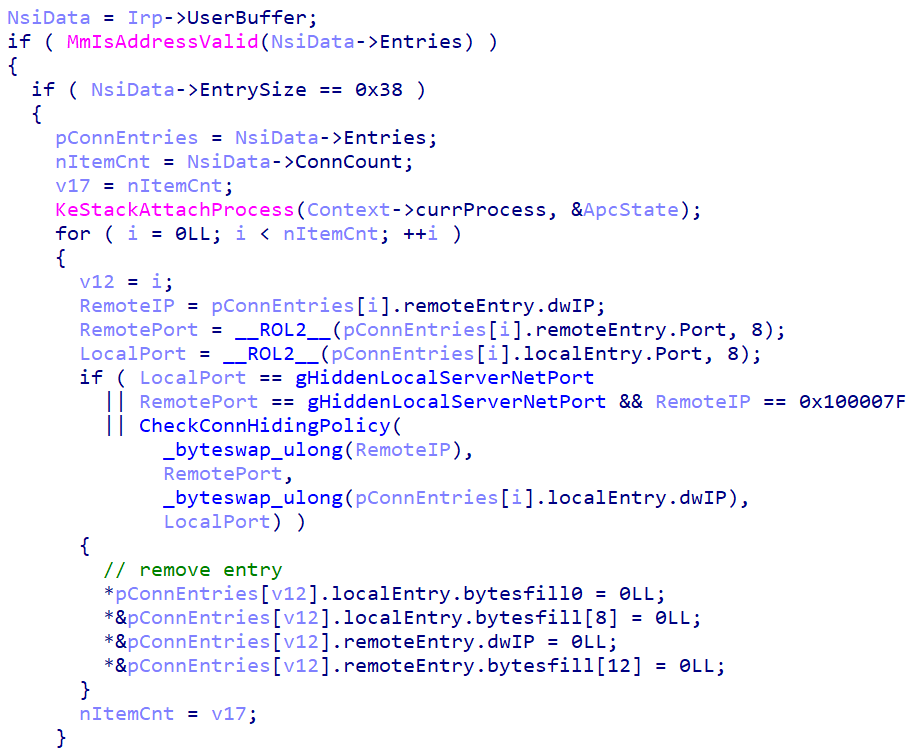
The driver can be configured to hide specific active connections (with a specified IP, port, or combination of both) so that they won’t be listed in the output of common network administration tools such as netstat.exe. This is achieved by a well-known technique (e.g., [1], [2], [3], … ), where attackers hook IoCompletionRoutine for IOCTL 0x12001B inside the DeviceIoControl function of the nsiproxy.sys Windows kernel driver. The code inside nsiproxy’s 0x12001B IOCTL handler is responsible for retrieving the list of active connections, and hooking its IoCompletionRoutine allows attackers to walk through the retrieved list, check for the presence of specific ports, addresses, or both, and hide the specific connection in the list if a match is found. Figure 8 shows the hook function responsible for hiding network connections.
In addition to the hiding of active network connections, the driver contains an interesting functionality allowing it to divert TCP packets received on any open TCP port, to the specified TCP port configured by the IOCTL 0x220200 (it’s actually the port of the SprySOCKS backdoor’s TCP server), but only in the case that the TCP data received contains specially crafted data. To achieve this, the driver registers its own packet filter objects using Windows Filtering Platform (WFP) API functions, manually parses contents of transferred IPv4 packets (both inbound and outbound traffic is inspected), and proceeds to divert the traffic if the specially crafted data is detected inside a received TCP packet data. The purpose of this feature seems to be mainly a capability to contact the malicious backdoor without the need to embed a C&C address inside the binary. Additionally, even though such diverted traffic can be inspected using tools such as Wireshark, the real port (the one the traffic is diverted to) is not revealed; thus it can be difficult to investigate the real destination for this malicious traffic.
Installed packet filters, along with their identifying information, are listed in Table 2.
Table 2. WFP filter objects registered by the RawWNPF driver
| Filter layer name | Filter object name and GUID | Filter object callout name and GUID |
| Inbound IP Packet v4 Layer | Delivery Optimization (TCP-In) {E980088D-BE44-4057-8E5C-C7FDF8968795} |
COInbound {DE0D7F67-94ED-4DDB-8215-9C028B54661B} |
| Outbound IP Packer v4 Layer | Delivery Optimization (TCP-Out) {33F76397-DBCB-445E-8EC3-AA51ED302D15} |
COOutbound {8280DDF3-7489‑4402-B9D8-96B50912346B} |
| ALE Connect v4 Layer | Delivery Optimization (TCP-In) {5746AF70-2917‑4861-97E6-D5E4DD569F2D} |
COAuthConnect {A33E1AA8-9B0F-44A3-B24A-AEB04CA54C3B} |
| ALE Listen v4 Layer | Delivery Optimization (TCP-In) {7CB4DFB4-0D20-402D-A49D-BA9660D026E6} |
COAuthListen {40045FAF-6BAE-4B48-9119‑31B48FFEA629} |
| ALE Receive/Accept v4 Layer | Delivery Optimization (TCP-In) {2C1AB6EF-0B65-4634‑8666-BCB2CF9C72E9} |
COAuthAccept {DDFE5189‑389F-437F-9B92-59495ED2181A} |
| ALE ResourceAssignment v4 Layer | Delivery Optimization (TCP-In) {B4AE248F-98D5-446F-88EB-14CF605AE722} |
COAuthResAssignment {FE570356-A1A9-413C-94CC-BD6C448E9969} |
Hiding the backdoor’s files
The driver hides/protects the SprySOCKS backdoor’s files by registering itself as a minifilter driver, and installing the following callbacks:
- pre-operation callback triggered on every IRP_MJ_CREATE I/O request and responsible for returning STATUS_NO_SUCH_FILE on every attempt to create or open a file or a directory from the driver’s list of hidden/protected files,
- pre-operation callback triggered on every IRP_MJ_DIRECTORY_CONTROL I/O request and responsible for filtering out non-directory-enumeration related requests, so that only the ones related to directory enumeration are passed to the post-operation callback, and
- post-operation callback triggered on IRP_MJ_DIRECTORY_CONTROL I/O requests that passed pre-operation callback checks. This callback is responsible for removing entries of hidden/protected files from any directory listing attempts.
The following hardcoded list of filenames are protected by the driver:
- \SystemRoot\Fonts\tpsvc.dll
- \SystemRoot\Fonts\tpsvcloc.dll
- \SystemRoot\Fonts\ApphostRagistreationVerifier.exe
- \SystemRoot\Fonts\X1B5206BDC1743DD.dat
- \SystemRoot\Fonts\KX1B5206BDC1743DD.dat
- \SystemRoot\Fonts\KW1B5206BDC1743FP.dat
Protecting persistence
The driver calls CmRegisterCallbackEx to install a RegistryCallback routine responsible for hiding the registry key used for the SprySOCKS loader’s persistence: HKLM\SOFTWARE\Microsoft\Windows NT\CurrentVersion\Image File Execution Options\vds.exe. As a result, all attempts to open or enumerate the key are filtered out by the driver.
WIN_PLUS components
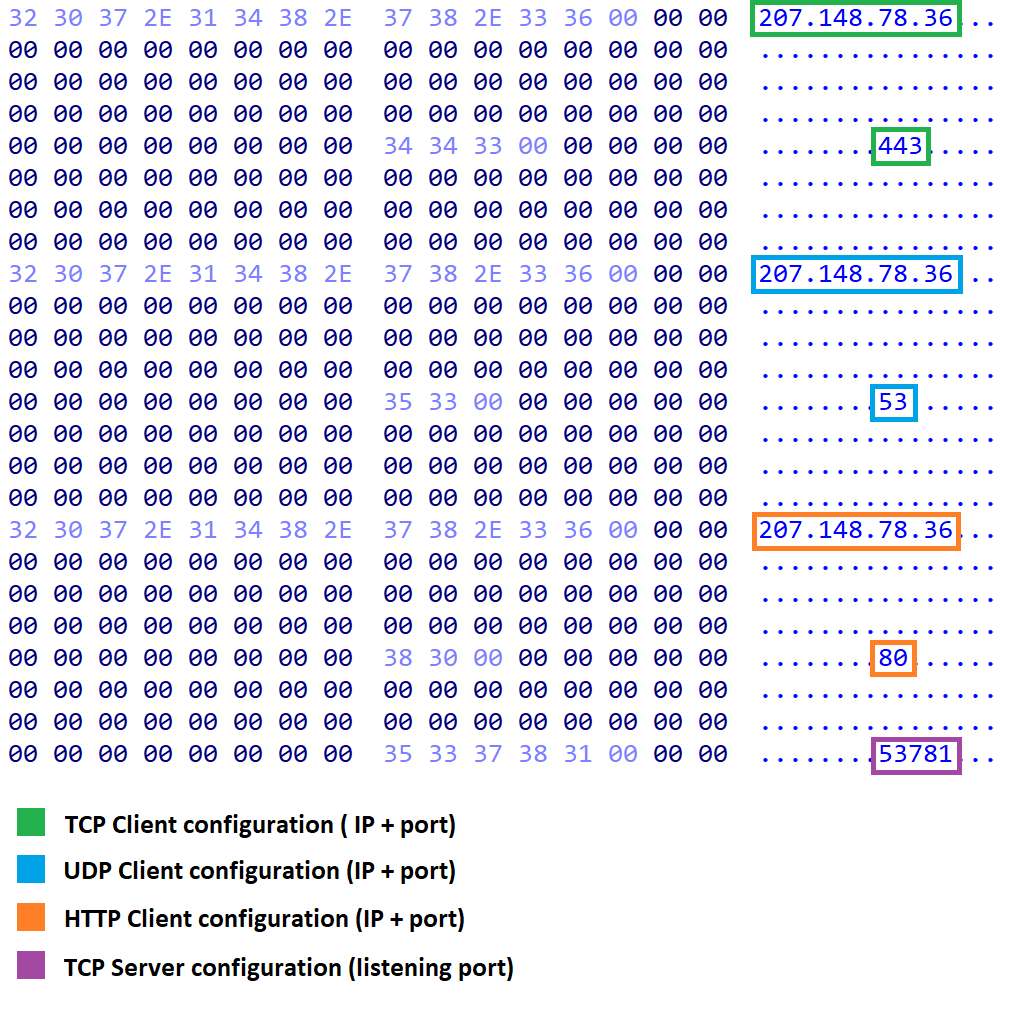
In the SprySOCKS WIN_PLUS version, we first discovered the malicious encrypted container in our telemetry, with the first hit dating back to July 2024 found on the device of a victim in Pakistan. It contained the SprySOCKS backdoor and the SprySOCKS loader. The C&C configuration was present and is shown in Figure 9.
The encrypted container was located at the following path on the compromised system:
C:\Windows\System32\spool\drivers\color\config.dat
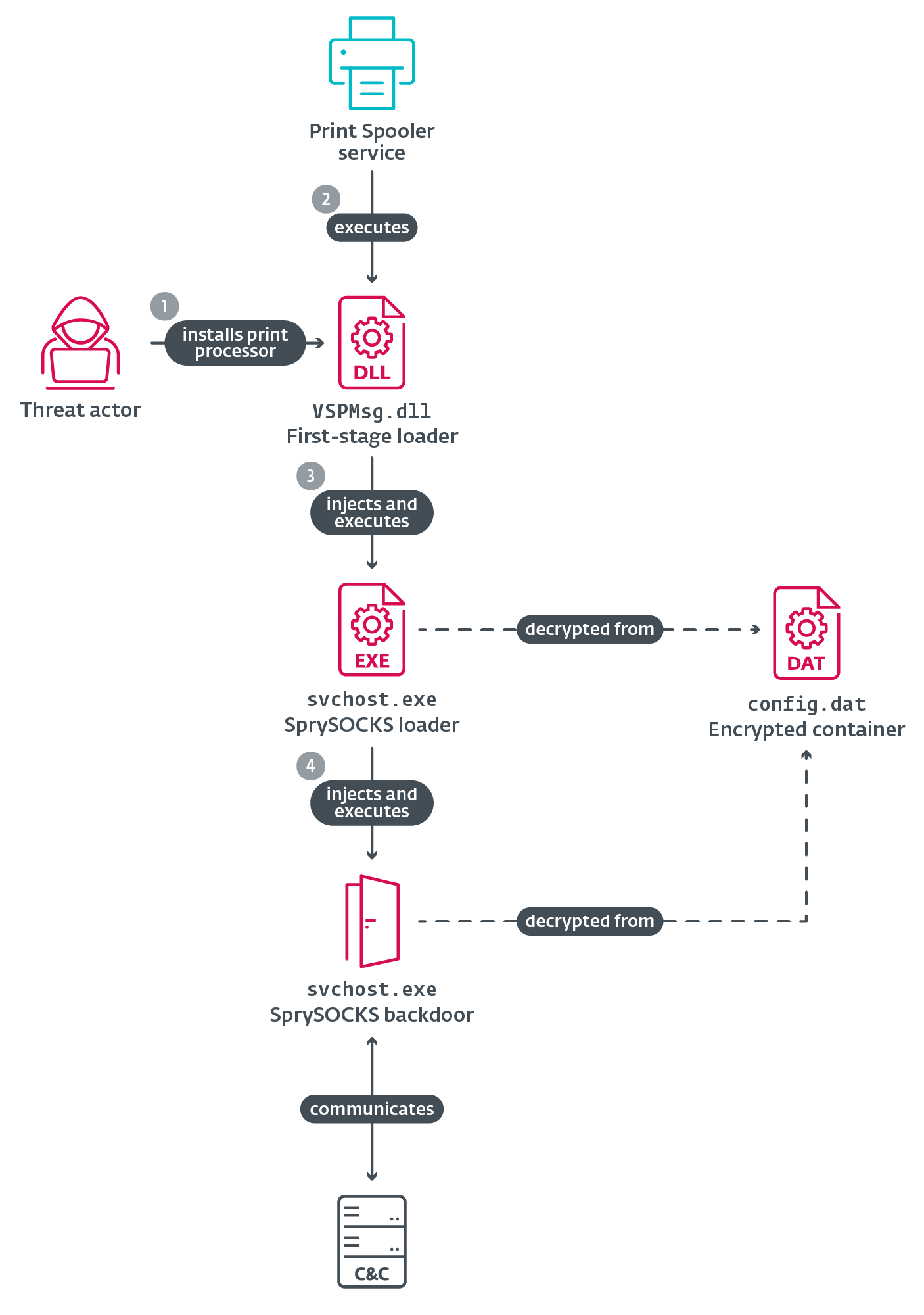
When decrypted, the container contains a SprySOCKS loader and the SprySOCKS backdoor itself. Further analysis of the SprySOCKS backdoor from the container showed that, in this case, there seemed to be an additional component responsible for loading the SprySOCKS loader from the encrypted container. This component – referenced to as the first-stage loader in this analysis – should be installed as a print processor under the following registry key:
HKLM\SYSTEM\ControlSet001\Control\Print\Environments\Windows x64\Print Processors\VSPMsg
Interestingly, when we searched our telemetry for anything related to this VSPMsg string, we discovered a file deployed on two different victim devices from Honduras at C:\Windows\System32\spool\prtprocs\x64\VSPMsg.dll. This file turned out to be the first-stage loader responsible for executing the SprySOCKS loader from the aforementioned config.dat file.
An execution diagram of the SprySOCKS WIN_PLUS variant is illustrated in Figure 10.
First-stage loader
This loader starts by checking whether it was executed by spoolsv.exe, and exits if not; this hides its behavior from automated malware analysis sandboxes, as the loader is intended to be run as a print processor. It continues decrypting the SprySOCKS loader from the encrypted container C:\Windows\System32\spool\drivers\color\config.dat. First it 128-bit AES-ECB decrypts the loader with the hardcoded key uXQLESMXGaRMs6BL, then injects it into the newly created svchost.exe process via process doppelgänging. Meanwhile, the SprySOCKS loader is dropped into a temporary file, with a filename prefix of TH, within the %TEMP% directory.
The sample exports two functions:
- GetErrorMessageModule
- SetErrorMessageModule
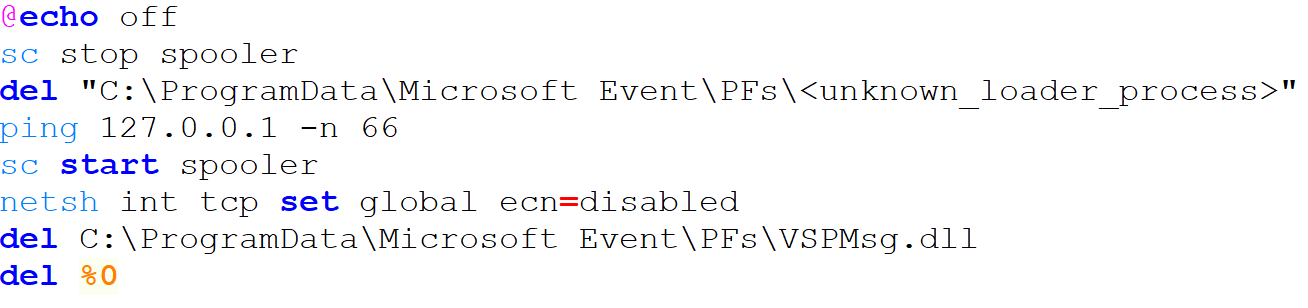
While the SetErrorMessageModule function does not do anything, the GetErrorMessageModule function is meant to be used to set persistence for the loader itself. When executed, it registers the loader as a print processor by creating the HKLM\SYSTEM\ControlSet001\Control\Print\Environments\Windows x64\Print Processors\VSPMsg registry key, setting the Driver registry value to VSPMsg.dll, and copying the hardcoded C:\ProgramData\Microsoft Event\PFs\VSPMsg.dll to the C:\Windows\System32\spool\prtprocs\x64\ directory. As the next step, it copies the encrypted container from C:\ProgramData\Microsoft Event\PFs\config.dat to C:\Windows\System32\spool\drivers\color\config.dat and, when done, it generates and drops the affair-build.bat batch script into the C:\Windows\System32\spool\drivers\color\ directory and executes it. As shown in Figure 11, this script’s purpose is to cover the loader’s tracks by removing the files in the original deployment directory, and triggering execution of the newly installed print processor by restarting the print spooler service.
SprySOCKS loader
This loader starts by creating a mutex with the hardcoded name fqwhi2d1qaz2, and then proceeds to loading the SprySOCKS backdoor from the encrypted container located at C:\Windows\System32\spool\drivers\color\config.dat. It 128-bit AES-ECB decrypts the backdoor with the hardcoded key uXQLESMXGaRMs6BL, then injects it into the newly created svchost.exe process via process doppelgänging. Meanwhile, the SprySOCKS loader is dropped into a temporary file, with a filename prefix of TH, within the %TEMP% directory.
SprySOCKS backdoor
Finally, we proceed to our analysis of the SprySOCKS backdoor itself. In both variants, WIN_DRV and WIN_PLUS, the backdoor functionality is almost the same, and the differences are only in the specific file paths used, registry keys used, and as already mentioned, the WIN_PLUS version does not use the RawWNPF driver for advanced stealthiness.
Both variants analyzed in this report are DLLs with the original name PrcsServer.dll, exporting a function named Stop. They create a mutex named prcs-server-run in the beginning and right after that proceed to the initialization of the backdoor’s main functionality, which includes initialization and launching of C&C communication channels (based on the hardcoded configuration) and setting up the keylogger. In addition to these actions, the WIN_DRV backdoor version initializes the RawWNPF driver by invoking its 0x222000 IOCTL handler, and then hides its own process by invoking the driver’s 0x220350 IOCTL.
Keylogging is activated only if there is an existing INI file at %appdata%\Microsoft\Vault\lgf.dat that contains a config section with a property named key that is set to 1. If these conditions are met, both backdoors create a mutex named Global\{DCAA7ED8-521B-4EAB-BE21-65254CF59239} and periodically log clipboard data along with the active window title and keystrokes into the file %appdata%\Microsoft\Vault\lg.dat. The data in the file is encrypted using a single-byte XOR cipher with the key 0x44.
C&C communication
The backdoor supports three protocols for communication with the C&C – TCP, UDP, and WebSocket – and can act as both client and server. The networking-related functionality is heavily based on the HP-Socket networking framework, and some cryptography functions were implemented using the Crypto++ library.
The C&C configuration is embedded in the backdoor, and can contain:
- up to three IP addresses and associated ports, each specifying a C&C IP address and its port for one of the communication channels (TCP, UDP, or WebSocket), and
- up to three port numbers, each specifying a port the backdoor should listen on for new connections. One is used for a TCP server, one for a UDP server, and one for a WebSocket server.
An example configuration from the WIN_PLUS version is shown in Figure 9 and it contains:
- The C&C address and port for the TCP communication channel: 207.148.78[.]36:443.
- The C&C address and port for the UDP communication channel: 207.148.78[.]36:53.
- The C&C address and port for the WebSocket communication channel: 207.148.78[.]36:80.
- The backdoor’s TCP server listening port: 53781.
Before initiating any connections or starting a server, the SprySOCKS WIN_DRV version hides any connections from/to the addresses or ports from the configuration by invoking the RawWNPF driver’s IOCTLs 0x220340 and 0x220200. As a result, these connections won’t be listed in output of tools such as netstat.exe, despite being active. In addition, both backdoor versions execute the netsh.exe utility twice:
netsh.exe netsh advfirewall firewall delete rule name="Core Networking - Packet Too Big(ICMPv6 - In)"
netsh advfirewall firewall add rule name="Core Networking - Packet Too Big(ICMPv6 - In)" dir=in action=allow protocol=tcp localport=53781
The first command deletes a specified firewall rule, and the second adds a new firewall rule of the same name as the one just deleted, allowing all inbound TCP traffic sent to the backdoor’s TCP server port specified in the configuration.
If the C&C configuration is empty (as in the case of the WIN_DRV version we discovered on VirusTotal), the backdoor starts a TCP server that listens on a random port on the compromised machine and also hides this port by invoking the RawWNPF driver’s IOCTL 0x220200. This invocation not only hides the TCP server from being listed in standard networking tools’ output, but also activates the TCP-diverting feature provided by the RawWNPF driver. This feature allows attackers to send commands to the backdoor without knowing the real port the backdoor listens on, simply by sending specially crafted TCP data to any open TCP port on the victim’s machine.
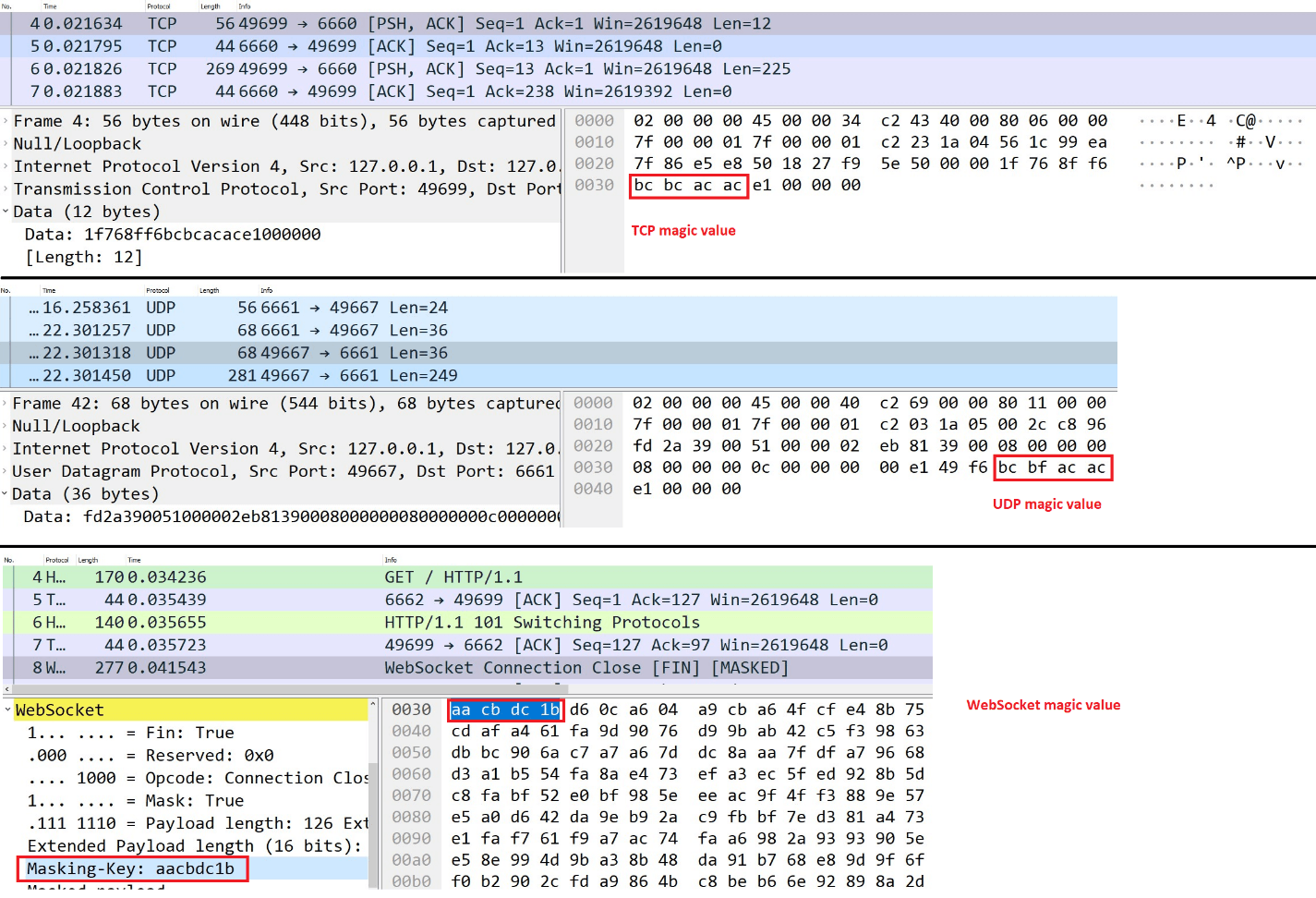
For the TCP communication channel, the C&C protocol seems to remain the same as in the Linux version analyzed in Trend Micro’s report. Each time before sending the actual backdoor’s data, it sends a 12-byte header containing the 32-bit CRC of the rest of the header, a DWORD magic value 0xACACBCBC, and a DWORD specifying the size of the data that follows the header.
For the UDP and WebSocket channels, the magic values are different, and so are the message header format and size. For the UDP channel, the magic value is 0xACACBFBC and it’s located at offset 0x1C in a 36-byte header, followed by a DWORD specifying the size of the data that follows. In the WebSocket channel, the magic value 0x1BDCCBAA is used as a Masking-Key in the WebSocket header. Figure 12 shows a network traffic capture with the magic values for each of the communication channels.
Following the header is, again, a 32-bit CRC, then the WORD value 0x0003 (likely indicating the encryption method), followed by 128-bit AES-ECB mode encrypted data (using the hardcoded key QFTHEYjzX3RBOMgZ) that has been base64 encoded.
An example of a C&C message before and after decoding and decryption is shown in Figure 13.
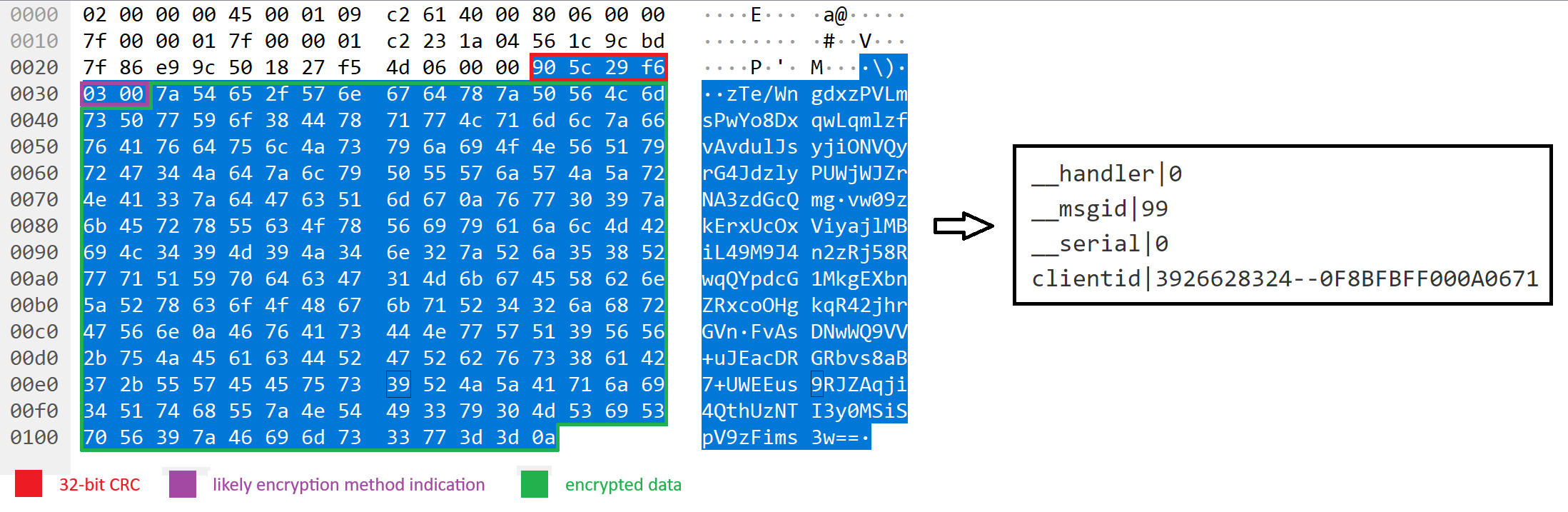
The __msgid value in the decrypted C&C message is used to specify a command, identified by a message ID, that should be executed by the backdoor. The list of message IDs supported by the backdoor, along with their description, can be found in Table 3. Note that we haven’t analyzed all these commands in depth; therefore, some descriptions are just a rough overview of the part of the code/functionality the message ID is related to.
Table 3. SprySOCKS C&C commands; descriptions marked with * are tentative assessments
| Message ID | Description |
| 0x09 | Collect client (victim) system information, including: computer name, OS version, network adapter information, information about memory, CPU information, current privileges, system language and version, current time, and the backdoor version (1.8) and version type (WIN_DRV or WIN_PLUS). |
| 0x0A | Start an interactive console. |
| 0x0B | Write into the interactive console. |
| 0x0D | Stop the interactive console. |
| 0x0E | Specify an additional communication channel (do not start the channel). Likely to specify an additional backup C&C. |
| 0x0F | Send C&C message to a different target.* |
| 0x11 | Enumerate all processes. |
| 0x12 | Enumerate modules of a process specified by a PID. |
| 0x13 | Terminate a process specified by a PID. |
| 0x14 | Close all connections. |
| 0x16 | Get current communication channel information. |
| 0x17 | Specify additional communication channels (TCP, UDP, or WebSocket) and start them. |
| 0x19 | Uninstall the backdoor and exit. |
| 0x1E | Enumerate all services. |
| 0x1F | Configure StartType for a specified service. |
| 0x20 | Start services with a specified name. |
| 0x21 | Invoke the ControlService function with a specified dwControl parameter. |
| 0x22 | Delete a specified service from the service manager. This does not stop the service if it’s running. |
| 0x23 | Initialize SOCKS proxy. |
| 0x24 | Terminate SOCKS proxy.* |
| 0x25 | Send data through SOCKS proxy. |
| 0x26 | SOCKS proxy-related command.* |
| 0x2A | Upload a specified file.* |
| 0x2B | File-transfer-related helper command.* |
| 0x2C | Download a specified file.* |
| 0x2D | File-transfer-related helper command.* |
| 0x3C | Enumerate free disk space. |
| 0x3D | List files in the specified directory. |
| 0x3E | Delete a specified file. |
| 0x3F | Create a specified directory. |
| 0x40 | Rename a specified file. |
| 0x41 | Execute an existing file. |
| 0x42 | Copy a specified file. |
| 0x43 | List files from the Recent Windows directories for the logged-in user: %APPDATA%\Microsoft\Windows\Recent\ %APPDATA%\Microsoft\Office\Recent\ |
Network infrastructure
Only one C&C address has been discovered in this campaign: 207.148.78[.]36, hardcoded in the configuration (shown in Figure 9) of the WIN_PLUS variant of the SprySOCKS backdoor.
Ports from the configuration that should be used by the backdoor to communicate with the C&C:
- TCP: 443
- UDP: 53
- WebSocket: 80
As mentioned in Trend Micro’s report, the IP address 207.148.75[.]122, from the same IP range 207.148.64.0/20 as the C&C above, was used by FishMonger operators as a SprySOCKS delivery server in June 2023. This IP range belongs to the Vultr cloud hosting provider.
Conclusion
The discovery of a Windows variant of SprySOCKS, previously known as Linux-only backdoor, represents a meaningful expansion of FishMonger's cross-platform capabilities. Our analysis shows that the Windows port retains most of the core architecture of its Linux predecessor – including the C&C protocol, encryption used, and overall command handling logic – while substituting Windows-native mechanisms where required and improving the stealthiness of the backdoor by bringing the kernel drivers to the game. Considering the limited indications of possible UEFI bootkit involvement, we advise everyone to keep a close eye on the group’s activities.
For any inquiries about our research published on WeLiveSecurity, please contact us at threatintel@eset.com.ESET Research offers private APT intelligence reports and data feeds. For any inquiries about this service, visit the ESET Threat Intelligence page.
IoCs
Files
| SHA‑1 | Filename | Detection | Description |
| 955BFC3DCC867256F9F4 |
KX1B5206BDC |
Win64/SprySOCKS.A | Encrypted SprySOCKS DriverLoader driver. |
| 44DC4A08C5EB0972C8E1 |
bthcam.sys | Win64/Agent.ESB | SprySOCKS DriverLoader driver. |
| AB87B29B6F79487C75CA |
KW1B5206BDC |
Win64/SprySOCKS.A | Encrypted SprySOCKS RawWNPF driver. |
| 6490B8E4AADE25A3EE2D |
X1B5206BDC1 |
Win64/SprySOCKS.A | Encrypted container of the encrypted WIN_DRV variant of SprySOCKS backdoor, encrypted SprySOCKS RawWNPF and SprySOCKS DriverLoader drivers. |
| E7484C24B88A1A2407A8 |
klelam00007 |
Win64/Agent.CXZ Win64/SprySOCKS.A BAT/Runner.KS |
ZIP archive from VirusTotal containing the WIN_DRV variant of SprySOCKS, along with all the backdoor's components; clean binaries used for side-loading are included. |
| 621D1952839BE4B0A1B0 |
tpsvcloc.dll | Win64/Agent.CXZ | SprySOCKS loader. |
| 2457EED2AB28E37741F1 |
VSPMsg.dll | Win64/Agent.CXZ | First-stage loader responsible for launching the SprySOCKS loader. |
| D2C706B1EAF662BF0CE1 |
N/A | Win64/SprySOCKS.A | WIN_PLUS variant of the SprySOCKS backdoor. |
| 5F3B87CEF56683D9A9E1 |
N/A | Win64/Agent.CXZ | SprySOCKS loader. |
| C793CA31E3F6628B5C89 |
config.dat | Win64/SprySOCKS.A | Encrypted container of the WIN_PLUS variant of the SprySOCKS backdoor and its loader. |
| 037DB2445F3D72388CB2 |
N/A | BAT/Runner.KS | Batch script that persists the WIN_DRV variant of SprySOCKS. |
Network
| IP | Domain | Hosting provider | First seen | Details |
| 207.148.78[.]36 | N/A | IRT‑CHOOPALLC‑AP | N/A | C&C IP hardcoded in the SprySOCKS backdoor (WIN_PLUS variant). |
MITRE ATT&CK techniques
This table was built using version 19 of the MITRE ATT&CK framework.
| Tactic | ID | Name | Description |
| Reconnaissance | T1592.004 | Gather Victim Host Information: Client Configurations | SprySOCKS can collect information about the compromised device, including: computer name, OS version, information about memory and CPU, current privileges, system language and version, current time, and more. |
| T1590.005 | Gather Victim Network Information: IP Addresses | SprySOCKS can collect information about the compromised device, including information about network interfaces and assigned IP addresses. | |
| Resource Development | T1587.001 | Develop Capabilities: Malware | FishMonger has developed custom malware for its operations, including the SprySOCKS backdoor. |
| Execution | T1059.003 | Command and Scripting Interpreter: Windows Command Shell | SprySOCKS can launch an interactive cmd.exe command shell, which allows the attackers to execute commands remotely on the compromised machine. |
| T1053.005 | Scheduled Task/Job: Scheduled Task | SprySOCKS uses a scheduled task to execute its loader on system start. | |
| T1569.002 | System Services: Service Execution | SprySOCKS abuses system services for both one-time and persistent execution. | |
| T1106 | Native API | FishMonger has used Windows APIs to execute code within a victim’s system. | |
| Persistence | T1547.012 | Boot or Logon Autostart Execution: Print Processors | To achieve persistence, FishMonger installs its malicious loader as a print processor. |
| Privilege Escalation | T1546.012 | Event Triggered Execution: Image File Execution Options Injection | SprySOCKS can install itself as a debugger for the Virtual Disk Service by modifying HKLM\SOFTWARE\Microsoft\Windows NT\CurrentVersion\Image File Execution Options\vds.exe\debugger. |
| Stealth | T1205.002 | Traffic Signaling: Socket Filters | SprySOCKS uses the RawWNPF kernel driver to install packet filters capable of redirecting any inbound TCP traffic to the configured local port if a special magic value is detected in the packet. |
| T1134.002 | Access Token Manipulation: Create Process with Token | FishMonger uses CreateProcessAsUser to execute a new process with a token obtained from the print spooler service. | |
| T1622 | Debugger Evasion | SprySOCK’s RawWNPF driver uses the KdDisableDebugger function to disable the kernel debugger, if active. | |
| T1140 | Deobfuscate/Decode Files or Information | SprySOCKS loader decrypts the SprySOCKS backdoor from an encrypted file. Additionally, most of the strings in the SprySOCKS components are encrypted. | |
| T1070.004 | Indicator Removal: File Deletion | The SprySOCKS loader removes original files from the deployment directory after copying them and setting up persistence. | |
| T1070.009 | Indicator Removal: Clear Persistence | SprySOCKS loader removes a service registry value associated with the previously installed malicious minifilter driver after executing the driver. | |
| T1027.007 | Obfuscated Files or Information: Dynamic API Resolution | SprySOCKS components use dynamic API resolution. | |
| T1027.013 | Obfuscated Files or Information: Encrypted/Encoded File | SprySOCKS components are stored in an AES-encrypted file on the victim’s drive. | |
| T1055.013 | Process Injection: Process Doppelgänging | The SprySOCKS loader uses process doppelgänging to inject the backdoor into the svchost.exe process. | |
| T1014 | Rootkit | FishMonger uses the RawWNPF kernel driver, which serves as a rootkit responsible for hiding the SprySOCKS malicious activity. | |
| T1497 | Virtualization/Sandbox Evasion | SprySOCKS uses several anti-emulation techniques to prevent automated analysis by emulators or sandboxes. | |
| T1574.002 | Hijack Execution Flow: DLL Side-Loading | FishMonger uses DLL side-loading to execute the SprySOCKS backdoor. | |
| Defense Impairment | T1562.004 | Disable or Modify System Firewall | SprySOCKS adds a firewall rule allowing any inbound traffic sent to the backdoor’s listening port. |
| Discovery | T1010 | Application Window Discovery | SprySOCKS retrieves the active foreground window name as a part of its keylogging functionality. |
| T1083 | File and Directory Discovery | SprySOCKS can obtain file and directory listings from the compromised system. | |
| T1518.001 | Software Discovery: Security Software Discovery | SprySOCKS components check for the presence of security and sandboxing product libraries (snxhk.dll, SxWrapper.dll, SxIn.dll, SXIn64.dll, SbieDll.dll, and cmdvrt32.dll) in their own processes. | |
| T1082 | System Information Discovery | SprySOCKS can collect information about the compromised device, including: computer name, OS version, information about memory and CPU, current privileges, system language and version, current time, and more. | |
| T1614.001 | System Location Discovery: System Language Discovery | SprySOCKS can collect information about the compromised device, including system language. | |
| T1007 | System Service Discovery | SprySOCKS can enumerate all services on the system. | |
| T1124 | System Time Discovery | SprySOCKS can collect information about the compromised device, including current system time. | |
| Collection | T1056.001 | Input Capture: Keylogging | SprySOCKS implements a keylogger. |
| T1115 | Clipboard Data | SprySOCKS logs clipboard data, along with the captured keystrokes, as a part of its keylogging functionality. | |
| Command and Control | T1132.001 | Data Encoding: Standard Encoding | SprySOCKS uses base64 encoding in its custom C&C communication protocol. |
| T1573.001 | Encrypted Channel: Symmetric Cryptography | SprySOCKS encrypts data sent to, and decrypts data received from, the C&C with 128-bit AES. | |
| T1008 | Fallback Channels | In addition to the TCP communication channel, SprySOCKS can contact its C&C using UDP and WebSocket channels. | |
| T1665 | Hide Infrastructure | SprySOCKS’s RawWNPF driver hides the backdoor’s active connections from being enumerated when using network tools such as netstat.exe. | |
| T1571 | Non-Standard Port | SprySOCKS uses nonstandard ports to communicate with the C&C. | |
| T1095 | Non-Application Layer Protocol | SprySOCKS uses nonstandard protocols to communicate with the C&C. | |
| Exfiltration | T1041 | Exfiltration Over C2 Channel | SprySOCKS can upload various files from the compromised system to the C&C. |