
ESET researchers analyzed the 2025 activity of Webworm, a China-aligned APT group that started out targeting organizations in Asia, but has recently shifted its focus to Europe. Even though this is our first public blogpost on the group, we have been observing Webworm’s activities ever since Symantec first reported on this threat actor in 2022. Over the years, we have seen that this threat actor continually changes its tactics, techniques, and procedures (TTPs).
Webworm is linked to other China-aligned APT groups such as SixLittleMonkeys and FishMonger. In the past, it made use of well-known malware families such as McRat (aka 9002 RAT) and Trochilus, though in recent years, it has started moving toward both existing and custom proxy tools, which are more stealthy than full-fledged backdoors. In 2025, Webworm also added two new backdoors to its toolset: EchoCreep, which uses Discord for C&C communication, and GraphWorm, which uses Microsoft Graph API for the same purpose. The group is also known for staging its malware and tools in GitHub repositories, ensuring that malware can be directly downloaded onto the victim’s machine.
Key points of the blogpost:
- Since its discovery in 2022, the Webworm APT group has been actively updating its toolset and targeting.
- In 2025, the group started employing backdoors that use Discord and Microsoft Graph API for C&C communication.
- ESET researchers decrypted over 400 Discord messages and a bash history file discovered on an operator server with reconnaissance commands used against more than 50 unique targets.
- In addition to backdoors, Webworm leverages multiple existing and custom proxy tools.
- The group uses GitHub to stage its malware.
We attribute the 2025 campaign to Webworm based on the information we discovered after decrypting the Discord messages used by the EchoCreep backdoor for C&C communication. The information led us to the attackers’ GitHub repository, which contained staged artifacts such as the SoftEther VPN application. Inside the SoftEther configuration file, we found an IP address that matches a known Webworm IP.
Victims who were impacted by Webworm from countries mentioned later in this blogpost have been appropriately notified. In addition, services we have identified, such as a GitHub repository and an S3 bucket, have been taken down.
Evolving approach
In 2022, one of Webworm’s main characteristics was the use of established backdoors and remote access trojans (RATs) such as McRat and Trochilus. As described in the Symantec blogpost, the group originally targeted mainly countries in Asia.
In 2024, we observed that the group started to move away from traditional backdoors in favor of legitimate or semi-legitimate tools, such as SOCKS proxies (SoftEther VPN) and other networking solutions. While these help Webworm evade detection, they also lack the full set of commands typically available in backdoors, so the operators have to rely on command interpreters such as cmd.exe or powershell.exe.
At that time, we also saw that the group started to slow down operations in Asia and shift its focus toward European countries. This trend continued in 2025, with the attacks we observed targeting governmental organizations in Belgium, Italy, Serbia, and Poland. At the same time, Webworm also made a foray into South Africa, compromising a local university.
In these latest campaigns, Webworm seems to have abandoned Trochilus and McRat altogether, while continuing to expand its toolset. Chief among the new tools are two new backdoors: the Discord-based EchoCreep, and the Microsoft Graph-based GraphWorm. While the group continued to use existing proxy solutions, specifically the Go-written iox (port forwarding and intranet proxy tool) and frp (fast reverse proxy), it also added custom proxy solutions WormFrp, ChainWorm, SmuxProxy, and WormSocket.
These custom proxy tools are not only capable of encrypting communications, but also support chaining across multiple hosts both internally and externally to a network. We believe that the operators use these tools in conjunction with SoftEther VPN to better cover their tracks and increase the stealth of their activities. All Webworm proxies and VPN services are cloud servers that belong to network infrastructure controlled by Vultr and IT7 Networks. Based on the number of proxy tools and their complexities, Webworm may be creating a much larger hidden network by tricking victims into running its proxies.
Discord and Microsoft Graph API C&C communication
In 2025, Webworm started abusing Discord and Microsoft Graph API for C&C communication. While analyzing the EchoCreep backdoor, we managed to uncover more than 400 Discord messages. We also found four unique channels, each corresponding to a different victim. EchoCreep uses Discord to upload files, send runtime reports, and receive commands. The backdoor’s network communication passes through Discord APIs using crafted HTTP requests.
In the case of GraphWorm, which uses Microsoft Graph API for C&C communication, we discovered that it uses OneDrive endpoints exclusively, specifically to get new jobs and to upload victim information. A separate OneDrive directory is created for each specific victim. Since the instance of OneDrive employed by GraphWorm is running in the cloud, the backdoor can leverage the Microsoft Graph API endpoint /createUploadSession to upload large, staged files.
Amazon S3 bucket
During our investigation of the 2025 campaigns, we discovered that Webworm had started using its custom proxy solution WormFrp to retrieve configurations from a compromised Amazon S3 bucket located at wamanharipethe.s3.ap-south-1.amazonaws[.]com. An Amazon S3 bucket is a public cloud storage solution available in Amazon Web Services, with the S3 standing for simple storage service. We believe that the compromised bucket is the publicly accessible – or even, possibly policy misconfigured – version of whpjewellers.s3.amazonaws[.]com.
Our initial review of the files stored in the bucket revealed several snapshots from virtual machine hosts, one of which contained the current configuration and active state of a machine belonging to a governmental entity in Italy. This could mean that the operators were able to successfully penetrate the environment responsible for managing the victim’s virtual machines. However, they could just as well have gained access to only a single host where snapshots were stored. Either way, it is apparent that through this S3 bucket, Webworm can exfiltrate data while an unsuspecting victim foots the bill for the service.
In late October 2025, the threat actors uploaded another file to the S3 bucket, an executable named SharpSecretsdump. This tool, as mentioned in its documentation, mimics the activity of the infamous secretsdump.py from Impacket to dump credentials from the affected Windows host it is deployed on. We assume that Webworm operators uploaded this tool to the S3 bucket for use against their victims.
Between December 2025 and January 2026, the operators uploaded 20 new files to the service, two of which had been exfiltrated from a governmental entity in Spain. The first of these two files, an XML file, contains the saved configurations of virtual hosts used by mRemoteNG, an open-source remote connection manager. The second file is a Microsoft Visio diagram detailing the infrastructure behind a domain used by this governmental entity.
GitHub repository
While going over EchoCreep’s Discord C&C infrastructure, we managed to retrieve Discord’s unique identifiers relating to users, channels, and guilds. Unfortunately, with limited access of the bot’s token, there were no API calls that could be used to enumerate the information surrounding the owners of the server or the bot itself.
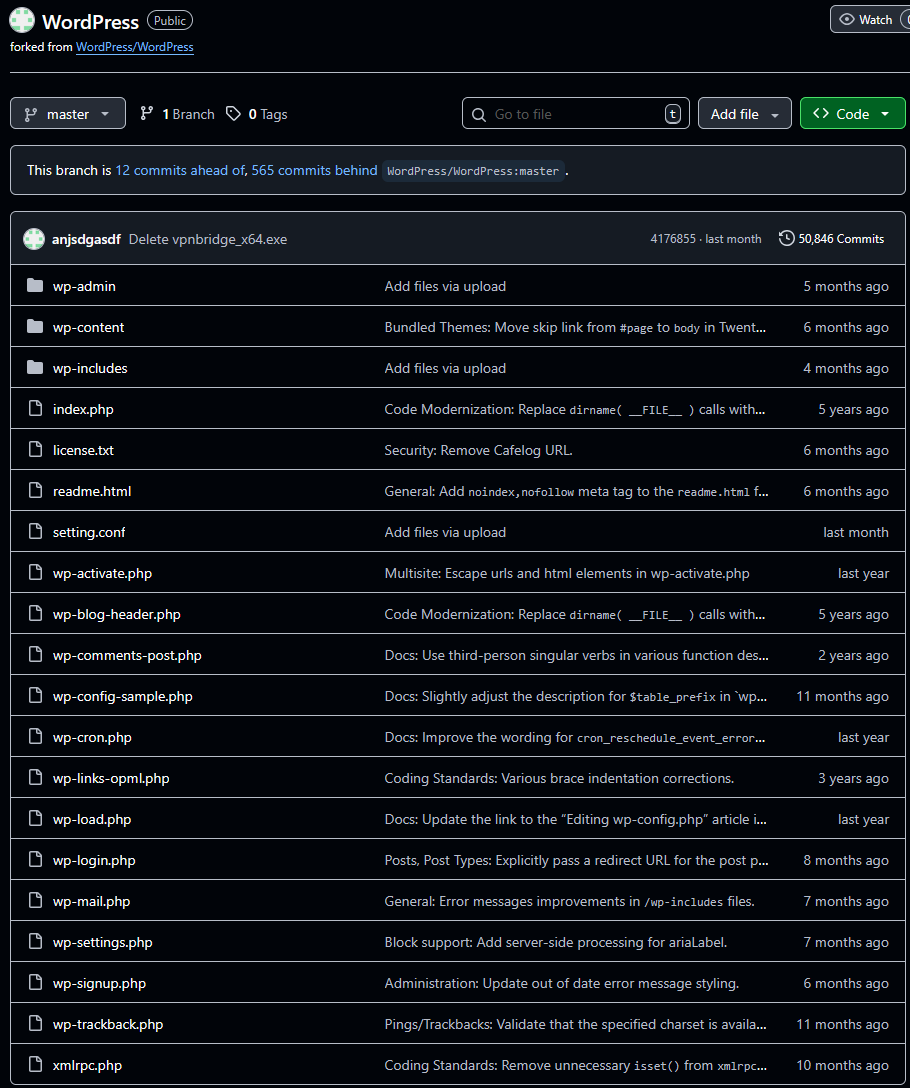
However, the Discord messages revealed the GitHub repository https://github[.]com/anjsdgasdf/WordPress, which acts as a file stager for other tools and malware used by Webworm (one such tool used the compromised Amazon S3 bucket mentioned above). As a direct fork of the legitimate WordPress repository, it could hide in plain sight. Figure 1 shows an overview of this repository, with staged files placed into the wp-admin directory.
Worming its way in
Even though we were unable to find the entry point that Webworm uses to compromise its victims, we have discovered that the group employs open-source utilities to scrape victim web server files and directories, and search for vulnerabilities within.
We found this after noticing that a victim machine was communicating with a proxy server hosted at 64.176.85[.]158. Review of the IP address showed that an open directory, which contained the aforementioned open-source utilities, had previously been hosted there on port 80. Figure 2 provides a top-level view into this open directory listing.
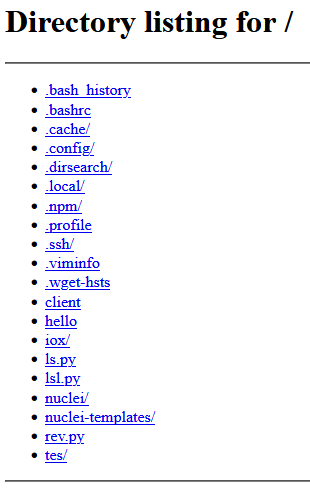
The key directories relevant to our blogpost are nuclei/, .dirsearch/, and the .bash history file. As can be seen in Figure 3, Webworm operators were able to brute force directories and files within web servers by using dirsearch, a web path scanner utility with the capability of filtering specific status codes, and nuclei, an open-source vulnerability scanner, to identify any possible vulnerabilities against specific targets.
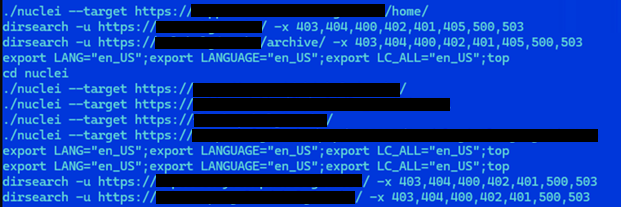
The results of running dirsearch were stored in the .dirsearch directory, which revealed that the tool had been executed against 56 targets from a variety of countries such as Spain, Hungary, Belgium, Nigeria, Czechia, and Serbia.
In the nuclei directory, we found the LegalHackers script, named _1.sh. It is a proof-of-concept exploit of CVE-2017-7692, a vulnerability allowing post-authentication remote code execution within the webmail client SquirrelMail. Looking in the .bash_history directory, we discovered that a similarly named script had been executed against a Serbian webmail target. This leads to the assumption that the group obtained the Serbian victim’s credentials and may have been using this vulnerability as part of initial access.
Toolset
In this blogpost, we look in detail at the new additions to Webworm’s arsenal. First, at its two custom backdoors: EchoCreep and GraphWorm. Then, at the custom proxy solutions that the group deployed in its 2025 campaigns: WormFrp, ChainWorm, SmuxProxy, and WormSocket.
EchoCreep
EchoCreep is a new backdoor, written in Go, that uses Discord as a C&C server, with messages beginning as early as March 21st, 2024. It is capable of executing the commands shown in Table 1.
Table 1. EchoCreep commands
| Command | Arguments | Description |
| upload | File path | Uploads a file, as an attachment, to Discord from the specified file system path. |
| download | Source (URL) and destination (path) | Downloads a file from the provided source URL to the file system path destination. |
| shell | String | Executes the string within a cmd.exe shell. |
| sleep | Integer (seconds) | Sleeps for the specified number of seconds before providing a success report back to the Discord server. |
While we were unable to confirm how the backdoor made its way onto the victim machine, it appears that persistence was only obtained post-compromise via C&C commands.
All of EchoCreep’s network communication is passed through Discord API endpoints using crafted HTTP requests. To parse commands, the backdoor first needs to decode them using base64, and then decipher them using AES-CBC-128. Figure 4 shows an example of a command and a reply after both have been decrypted.
{"guild": "lol", "channel_id": 1220298277849796651, "channel": "fire", "content": "shell whoami", "time": "2025-04-14T08:35:41.751000+00:00", "author_id": 1219910976007045171, "author": "jonson889912"}Figure 4. EchoCreep command and reply
From all 433 Discord messages we decrypted, it was not evident exactly who was impacted since they are not ESET customers. However, we were at least able to determine the number of victims compromised by EchoCreep based on channel names. We discovered that these names were either the victim’s IP address, or a combination of the IP address and the victim machine’s hostname. Having found four unique channels using this naming convention, we believe that there are four victims.
Upon EchoCreep’s first execution, it does not attempt to create a new channel, but sends a message saying Up Success to a channel that already exists (see Figure 5 and Figure 6). This indicates that the channels were created prior to the execution of the backdoor, suggesting that the operators either knew the targets or exfiltrated the necessary information following initial access.


The earliest messages, sent from March 21st, 2024 to March 31st, 2025, appear to have been operator test commands. Figure 7 shows that the threat actors left some information about their local IP configurations in there.
Ethernet adapter Ethernet0:
   Connection-specific DNS Suffix  . : lan
   Link-local IPv6 Address . . . . . : fe80::2111:d79b:b1ba:1f4a%10
   IPv4 Address. . . . . . . . . . . : 192.168.8.174
   Subnet Mask . . . . . . . . . . . : 255.255.255.0
   Default Gateway . . . . . . . . . : 192.168.8.1
Figure 7. Windows ipconfig output
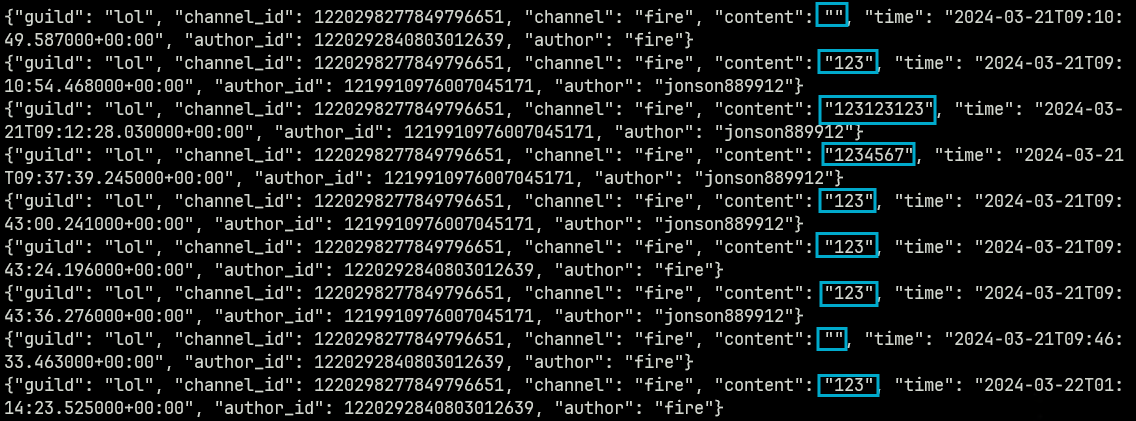
Many of the other earlier messages contained garbage values, possibly used as a test to identify proper communication, as seen in Figure 8.
Soon afterwards, we began to see download operations take place like those in Figure 9, showing the development of advanced commands.

In addition, in Figure 10, we see testing activities that may have been early adaptations of the persistence mechanism that Webworm would use later against victims. What’s also interesting is that it executes the run command instead of the eventually used shell command, supporting our determination that these were early tests.

The first actual compromise took place on April 9th, 2025, when new Up Success messages appeared in the logs associated with a new channel name. Shortly after the initial compromise, the threat actor used shell commands to execute curl to download files.
GraphWorm
GraphWorm is another new backdoor wielded by Webworm. It executes itself whenever the victim logs in to the machine. GraphWorm uses the Microsoft Graph API for C&C communication, showing that Webworm has new infrastructure in place to compromise victims, storing information within a Microsoft Graph tenant. Based on what we’ve seen, the backdoor exclusively uses OneDrive to receive commands and send victim data. The data involved in these communications is first AES-256-CBC encrypted using OpenSSL EVP library calls, and then base64 encoded. GraphWorm also allows for proxy settings to be configured, thus tunneling any traffic through the specified proxy.
On first execution, the backdoor creates a unique victim ID by concatenating the network adapter IP, processor ID, and the serial number of a physical device using the WMI framework.
The unique ID is used in the process to rename or create a new OneDrive folder within the tenant. Each folder is unique to a compromise, containing specific subfolders under each victim. The three subfolders /files, /result, and /job are used to store files, results of commands executed on the victim machine, and jobs queued by the operators to execute, respectively.
After the folder has been created successfully, the backdoor collects information about the victim machine, resulting in the JSON object seen in Figure 11.
{
    "Host Name": "<computer_name>",
    "IP Address": "<ip>",
    "MAC Address": "<mac>",
    "Operating System": "<os>",
    "Privilege": "<Admin|Regular User>",
    "Time Zone": "<UTC-XXXX>",
    "User Name": "<username>",
    "Workgroup": "<workgroup",
    "publicKey": "<key>"
}
Figure 11. Configuration structure
The commands that GraphWorm receives through OneDrive are described in Table 2, in order of discovery.
Table 2. GraphWorm commands
| Command | Arguments | Description |
| keyExchange | String <adminPublicKey> | This value is set in memory and unfortunately its purpose is not easily identifiable. It could be used to set a public key within the application to gain reverse shell access. |
| sessionKey | String <sessionKey> String <keyId> | Another set of values set within memory and not evident how they are used. Believed to be an RSA private key and AES key to be updated in memory and used for cryptographic functions. |
| kill | N/A | Stops the execution of the backdoor. |
| shell | N/A | Spawns a new instance of cmd.exe. |
| exec | File path | Executes a new process using CreateProcessW. |
| upload | String <onedrive_path> String <agent_path> | Downloads a file based on the OneDrive and agent path. The <onedrive_path> is believed to be the full path as it appears in OneDrive, resulting in the format of /me/drive/root:/<onedrive_path>, and <agent_path> is the full file path as it appears on disk. |
| sleep | Integer | Updates sleep duration. |
| poll | Integer | Updates sleep duration for an undetermined reason. Possibly because the development of commands is still ongoing. |
| rest | Integer | Sleep for a duration of time. |
| upgrade | JSON text | The JSON text contains configuration settings to update fields in memory, followed by writing of these changes to the config.dat file on disk. |
| download | String <onedrive_path> String <file_path> | Uploads the file from the provided <file_path> to the path desired in OneDrive. <onedrive_path> is believed to be in the format of /me/drive/root:/<uniqueid>/<filename>/:content. |
| heartbeat | Integer <min> Integer <max> | Used to create a random delay period between the min and max of how long to wait to update alive.txt. |
During our research, we noticed that upon completion of the shell command, the results were written to a file beacon_shell_output.txt and saved in a temporary directory. To upload these large shell command outputs, the operators most likely leveraged the Microsoft Graph API endpoint /createUploadSession, since the backdoor deals with a cloud instance of OneDrive.
WormFrp
WormFrp is a proxy tunneling tool inspired by the existing fast reverse proxy (frp) utility that Webworm also uses. The threat actors expanded frp with custom functionalities so that the tool can obtain its configuration values from a compromised Amazon S3 bucket, wamanharipethe.s3.ap-south-1.amazonaws[.]com.
The compromised S3 bucket contains several files with .txt extensions that are AES encrypted using ECB mode. Each WormFrp instance is hardcoded with a unique AES key and retrieves a unique file from the S3 bucket. The configuration file is updated during WormFrp execution to send information back to the operator to identify where the tunnel connects from.
WormFrp requires a command line argument to run. After obtaining its configuration from the S3 bucket, WormFrp attempts to log into an frp server, opening a reverse proxy and TCP SOCKS5 proxy. Based on observed samples, the username and password are always randomly generated.
Each instance of WormFrp connects to an frp server through a public IP address. Additional network activity may be seen from the victim’s machine once the reverse proxy is configured.
ChainWorm
ChainWorm is another custom proxy tool used by Webworm operators. It appears that ChainWorm’s main function is to assist in expanding Webworm’s network infrastructure of proxies by opening a port on the machine on which it is deployed. Webworm can use this tool to chain proxies where specifically crafted data is sent through the port connecting to another remote system, forwarding the traffic to the next destination for an indeterminate number of hops.
Typically, the port that is opened on the impacted host is hardcoded in the tool. TCP connections are then opened on the hardcoded port to receive any transmissions that would lead to additional outbound connections of either a direct IP address or hostname along with its port.
Using the combination of the hostname and port, a connection is made to the next hop in the chain. With connections established between source and destination, any data passed through is now forwarded to the next upstream hop in the chain. If at any point there is an exception, the source is notified with the 0x05 01 00 01 00 00 00 00 00 00 byte sequence before attempting to reconnect.
SmuxProxy
SmuxProxy is a utility based on iox, a port forwarding and intranet proxy tool. On top of the existing iox functionality, SmuxProxy contains small customizations to allow for a hardcoded server IP address and port, making it easier for operators to drop and execute. It can also generate a random key and initialization vector for encrypted communications.
WormSocket
The last of Webworm’s new custom proxies is WormSocket, a tool that makes use of configured servers running socket.io to establish a proxy for web requests. WormSocket allows for a highly configurable and scalable proxy network, allowing specific nodes to be interacted with at any given time.
Its configuration relies on both hardcoded values and command line arguments. WormSocket accepts an optional command line argument --proxy followed by a URI containing basic authentication, used as a configuration to create a WebProxy object. The proxy is then used on top of a connection to a web socket. Configurations for this web socket are hardcoded in WormSocket.
Once WormSocket has started, it first connects to the configured IP address and port by attempting connections using ws, wss, http, and https schemes. Once a successful connection is made, an asynchronous task is spawned to receive and send new messages. There are four possible message types, described in detail in Table 3.
Type
Message class
Values
Description
1
InitiateForwarderClientReq
String <ForwardedClientId>
Uses the IpAddress field to perform a DNS lookup to obtain the host address of a possible domain passed through, the result of which is used to create a new TCP client with the Port. Once the client establishes connectivity, it is stored within a dictionary of ForwardedClientId and TcpClient pairs.
In addition, a new InitiateForwarderClientRep message object is created with the same information used to build the TCP client, and sent with the messages read through the client and stored in a ConcurrentQueue for later use.
String <IpAddress>
Integer <Port>
2
InitiateForwarderClientRep
String <ForwarderClientId>
ForwarderClientId is used to look up an already configured TCP client created by InitiateForwarderClientReq in the client dictionary, all other values appear to not be in use. Once the TCP client is retrieved, new messages are read and stored in a ConcurrentQueue for later use.
String <BindAddress>
Integer <BindPort>
Integer <AddressType>
Integer <Reason>
3
SendDataMessage
String <ForwarderClientId>
Sends the Data through base64 encoding followed by the TCP client associated with ForwarderClientId.
Bytes[] <Data>
4
CheckInMessage
String <MessengerId>
Assigns MessengerId to the internal MessengerId, which does not appear to be used for anything.
Conclusion
Webworm is a China-aligned APT group active since at least 2022. It employs a constantly evolving toolkit comprising mainly backdoors and a combination of open-source and custom proxy utilities. In the 2025 campaigns we observed, Webworm began using Discord-based (EchoCreep) and Microsoft Graph API-based (GraphWorm) backdoors. The group also continues to stage files in GitHub repositories, and we can only assume that it will keep doing so in the future.
Through our analysis, we were fortunate enough to recover commands executed from a server that gave a view into the group’s potential initial access techniques, using an open-source vulnerability scanner, as well as identifying some of its targets.
It is clear that Webworm is a very active APT group that will continue looking to use new tools to compromise its victims, whether this be from an initial access point, or post compromise.
For any inquiries about our research published on WeLiveSecurity, please contact us at threatintel@eset.com.ESET Research offers private APT intelligence reports and data feeds. For any inquiries about this service, visit the ESET Threat Intelligence page.
IoCs
A comprehensive list of indicators of compromise (IoCs) and samples can be found in our GitHub repository.
Files
| SHA-1 | Filename | Detection | Description |
| CB4E5043333670738142 |
SearchApp.exe | WinGo/Agent.ZK | EchoCreep backdoor using Discord for C&C. |
| 1DF40A4A31B30B62EC33 |
ssh.exe | WinGo/HackTool. |
WormFrp proxy tool. |
| 7DCFE9EE25841DFD58D3 |
svc.exe | MSIL/HackTool. |
WormHole proxy tool. |
| 77F1970D620216C5FFF4 |
C2OverOneDrive_v |
Win32/Agent.VWD | GraphWorm backdoor using the Microsoft Graph API for C&C. |
| 948159A7FC2E68838686 |
MessengerClient. |
MSIL/HackTool.P |
WormSocket proxy tool. |
| A3C077BDF8898E612CCD |
dsocks.exe | WinGo/Riskware. |
SmuxProxy, a custom iox with hardcoded IP. |
Network
| IP | Domain | Hosting provider | First seen | Details |
| N/A | wamanharipethe. |
N/A | 2025-04-14 | Compromised S3 for frp configurations and data exfiltration. |
| 45.77.13[.]67 | N/A | Vultr Holdings, LLC | 2025-04-07 | WormSocket web socket server. |
| 64.176.85[.]158 | N/A | The Constant Company, LLC | 2025-06-28 | SmuxProxy server. |
| 104.243.23[.]43 | N/A | IT7 Networks Inc | 2025-04-09 | SmuxProxy server. |
| 108.61.200[.]151 | N/A | Vultr Holdings, LLC | 2025-04-10 | WormFrp proxy server. |
| 144.168.60[.]233 | N/A | IT7 Networks Inc | 2025-06-30 | Reverse shell IP discovered on SmuxProxy server. |
MITRE ATT&CK techniques
This table was built using version 19 of the MITRE ATT&CK framework.
| Tactic | ID | Name | Description |
| Reconnaissance | T1595.002 | Active Scanning: Vulnerability Scanning | Webworm utilized the open-source vulnerability scanner nuclei against targets. |
| T1595.003 | Active Scanning: Wordlist Scanning | Webworm used dirsearch, which leverages wordlists, to perform web directory scanning on targets. | |
| Resource Development | T1588.006 | Obtain Capabilities: Vulnerabilities | Webworm used publicly available exploit code for post-authentication remote code execution. |
| T1583.004 | Acquire Infrastructure: Server | Servers for WormFrp, SmuxProxy, and WormSocket are hosted on cloud services operated on Vultr and IT7 Network ASNs. | |
| T1583.003 | Acquire Infrastructure: Virtual Private Server | Webworm makes use of SoftEther VPN servers that have been seen hosted on Vultr cloud services. | |
| T1584.006 | Compromise Infrastructure: Web Services | Webworm has been seen compromising S3 buckets as well as using tools like nuclei to find footholds. | |
| T1608.002 | Stage Capabilities: Upload Tool | Webworm staged tools in its GitHub repo for direct download onto compromised systems. | |
| Execution | T1059.003 | Command and Scripting Interpreter: Windows Command Shell | EchoCreep and GraphWorm both use the Windows command line to execute operator commands. |
| T1053.005 | Scheduled Task/Job: Scheduled Task | EchoCreep is executed under the custom-created MicrosoftSSHUpdate scheduled task. | |
| Persistence | T1547.001 | Boot or Logon Autostart Execution: Registry Run Keys / Startup Folder | GraphWorm persists by making updates to registry Run keys. |
| Defense Impairment | T1070.004 | Indicator Removal: File Deletion | GraphWorm cleans up a created beacon file after successful upload. |
| T1112 | Modify Registry | GraphWorm makes modifications to registry Run keys for persistence. | |
| T1027.013 | Obfuscated Files or Information: Encrypted/Encoded File | GraphWorm and EchoCreep use encryption and encoding techniques to obfuscate data. | |
| T1550.001 | Use Alternate Authentication Material: Application Access Token | GraphWorm and EchoCreep use API keys to communicate with the C&C infrastructure. | |
| T1078.004 | Valid Accounts: Cloud Accounts | GraphWorm uses a valid cloud account to access Microsoft Graph APIs. | |
| T1070.006 | Indicator Removal: Timestomp | EchoCreep contains a modified timestamp attribute. | |
| Lateral Movement | T1021.007 | Remote Services: Cloud Services | Webworm makes use of a compromised S3 bucket to use as a file staging zone. |
| Collection | T1005 | Data from Local System | Both EchoCreep and GraphWorm can collect data from the local system. |
| T1074.001 | Data Staged: Local Data Staging | GraphWorm stages a beacon file locally before uploading to the C&C. | |
| T1074.002 | Data Staged: Remote Data Staging | GraphWorm stages files and tasks within OneDrive via the Microsoft Graph API. | |
| Command and Control | T1071.001 | Application Layer Protocol: Web Protocols | EchoCreep, GraphWorm, and WormSocket make use of HTTP and the WebSocket protocol. |
| T1132.001 | Data Encoding: Standard Encoding | EchoCreep, GraphWorm, and WormSocket make use of base64 encoding. | |
| T1573.002 | Encrypted Channel: Asymmetric Cryptography | EchoCreep, GraphWorm, WormSocket, and WormFrp use AES in some capacity. | |
| T1090.003 | Proxy: Multi-hop Proxy | WormSocket and ChainWorm create multiple proxy hops. | |
| T1090.002 | Proxy: External Proxy | WormFrp, ChainWorm, WormSocket, SmuxProxy, and GraphWorm have the capability to connect to external proxies. | |
| T1090.001 | Proxy: Internal Proxy | ChainWorm and WormSocket can create internal proxies. | |
| T1102.002 | Web Service: Bidirectional Communication | EchoCreep and GraphWorm use Discord and the Microsoft Graph API for C&C infrastructure. | |
| Exfiltration | T1041 | Exfiltration Over C2 Channel | EchoCreep and GraphWorm exfiltrate data to their respective C&C infrastructures. |
| T1567.002 | Exfiltration Over Web Service: Exfiltration to Cloud Storage | GraphWorm exfiltrates data to OneDrive via the Microsoft Graph API. |