
ESET researchers analyzed the robust EDR-killing toolset of the ransomware-as-a-service gang Gentlemen. Since the beginning of 2026, Gentlemen has emerged as one of the most active gangs in the ransomware ecosystem. The group distinguishes itself through a mature, operator-maintained set of endpoint detection and response (EDR) killers, i.e., tools for disrupting security software. Additionally, unlike most top-tier gangs, Gentlemen does not exhibit a strong US-centric victimology, instead targeting victims across Southeast Asia, South America, and Western Europe.
While there have been multiple reports covering Gentlemen in recent months, they have not focused on a detailed analysis of the group’s EDR killers. Thanks to ESET’s continued incident-level visibility, we can however provide a uniquely deep view into Gentlemen’s EDR-killer development practices. The internal data leak that Gentlemen suffered in May 2026 then gave us even more insight into the inner workings of the group.
The leak also allowed us to confirm our hypothesis from February 2026 that Gentlemen operators actively develop and maintain a portfolio of EDR killers that they offer to affiliates, centered around their in-house framework we have named GentleKiller. They also incorporate third-party or leaked tools such as HexKiller, ThrottleBlood, and HavocKiller. These tools are standardized through a shared defense-evasion layer, impersonating predominantly security vendors using fake version information, and copied legitimate certificates and icons. Gentlemen also demonstrates an ability to unusually quickly operationalize newly disclosed Bring Your Own Vulnerable Driver (BYOVD) proofs-of-concept, often within days of public release.
In this blogpost, we share our findings on Gentlemen’s suite of EDR killers gained through extensive research and corroborated by the recent leak. We aim to provide actionable insights by connecting the EDR killer packages to actual samples, and tying the leaked data to tactics, techniques, and procedures (TTPs). Our findings highlight Gentlemen as one of the most technically agile ransomware-as-a-service (RaaS) gangs active in 2026.
Key points of the blogpost:
- Gentlemen operators develop and maintain an EDR-killer suite provided directly to affiliates.
- GentleKiller is an in‑house framework with at least eight variants abusing different vulnerable or malicious drivers.
- Gentlemen operators apply a unified evasion strategy across tools that standardizes impersonation and protection.
- Third‑party EDR killers (HexKiller, ThrottleBlood, and HavocKiller) are operationally integrated.
- Gentlemen can rapidly adapt newly released EDR killer proofs-of-concept (PoCs).
- The gang’s victimology is globally distributed and notably not US‑focused.
- Gentlemen also uses OxideHarvest, a credential stealer maintained by one of the group’s affiliates.
Throughout this blogpost, we refer to RaaS operators and affiliates.
Operators are responsible for developing the ransomware payload, managing decryption keys, maintaining the dedicated leak site, often negotiating the ransom payment with victims, and offering other tooling and services for a monthly fee or a percentage from the ransom payment (typically 5–20%).
Affiliates rent ransomware services from operators, deploy encryptors to victims’ networks, and are also responsible for data exfiltration.
Gentlemen profile
Gentlemen emerged in late 2025 as a RaaS operation and quickly grew into one of the most active ransomware gangs observed in Q1 2026. The gang offers a generous 90% share to affiliates. Group-IB disclosed that Gentlemen was founded by hastalamuerte, a disgruntled former Qilin affiliate. PRODAFT tweeted on October 17th, 2025 that Gentlemen operators were previously affiliates of Qilin, Embargo, LockBit, Medusa, and BlackLock. On June 10th, 2026 Brian Krebs shared evidence of hastalamuerte’s true identity.
Gentlemen utilizes double extortion – in addition to encrypting the victim data, the group also threatens to leak it if the ransom is not paid. For encryption, the operators offer a variant written in Go targeting Windows, Linux, and other platforms, and an ESXi variant written in C.
One of the things that sets Gentlemen apart is the gang’s willingness to offer more than just encryptors to affiliates – in particular, the gang also provides EDR killers. Recent ESET research has shown that, in most ransomware intrusions, the responsibility for finding a reliable EDR killer typically falls on individual affiliates, not the RaaS operators themselves. Only a small number of exceptions to this model have been documented. One notable case is RansomHub, which invested in developing its own EDR killer from scratch, EDRKillShifter, and then offered it to affiliates through the affiliate panel.
Gentlemen represents a different, and so far underreported, approach. Rather than relying on affiliates to source their own EDR killers, Gentlemen operators actively develop and maintain a portfolio of EDR killers for affiliates. This portfolio combines an in-house developed tool, which we named GentleKiller, along with externally sourced or leaked tooling, standardized through a shared evasion layer and staged in a consistent manner.
ESET researchers hypothesized that GentleKiller was an internal tool back in February 2026, and this was later supported by reports from Group-IB and Check Point – both mention that the gang provides EDR-killing capabilities to its (verified) affiliates. The recently leaked internal data of the gang provided the final piece of evidence: in the leaks, zeta88 (another alias used by hastalamuerte), the leader of the gang, openly talks about maintaining and providing EDR-killer packages.
Apart from confirming our suspicion about GentleKiller, the leaked data also allowed us to link a credential stealer we named OxideHarvest to Gentlemen; specifically, to one of its affiliates.
Victimology
While the victimology of large RaaS operations is often shaped more by affiliates’ choices than by operator-led strategy, one particular pattern still tends to emerge. Most major ransomware gangs show a strong and persistent focus on the United States, which frequently accounts for roughly half of all announced victims. This US-centric bias is evident across several prominent groups, including Qilin, DragonForce, and Akira, and has effectively become the norm among top-tier ransomware operations.
Gentlemen stands out as a notable exception to this trend. Despite ranking among the five most active ransomware gangs in Q1 2026, its victimology does not exhibit a comparable US focus. Instead, Gentlemen affiliates consistently target victims across a broad and geographically diverse range of countries, with a significant number of victims coming from regions such as Southeast Asia, South America, and Western Europe. Indeed, the gang’s targeting includes some otherwise unusual countries like Thailand, Brazil, and France.
The recently leaked data provides evidence that when it comes to choosing victims, Gentlemen utilizes a centralized approach of sorting through viable candidates and then distributing them to affiliates. Victims are chosen primarily based on their FortiGate (mis)configuration rather than their geographical location.
EDR Killers
In February 2026, we saw a previously undocumented EDR killer deployed by a Gentlemen affiliate and staged in a directory named GentlemenCollection. We named this tool GentleKiller. At the time, we hypothesized that it was not an affiliate-specific artifact but rather a tool provided to affiliates by the Gentlemen operators. Since then, we have observed the same staging pattern (dropping GentleKiller and other EDR killers to the GentlemenCollection directory) multiple times across unrelated intrusions that we investigated, consistently involving Gentlemen affiliates. In parallel, two independently published reports by Group-IB and Check Point assessed that the Gentlemen operators explicitly offer EDR-disabling capabilities as part of their RaaS program.
Taken together, these observations allowed us to conclude that GentleKiller is a component of an EDR-killer suite maintained by the Gentlemen operators. This was later confirmed in the group’s leaked data.
Besides GentleKiller, the suite also contains HexKiller, HavocKiller, and ThrottleBlood; all ESET names for EDR killers used by affiliates of rival gangs too and obtained by Gentlemen via unknown means. We also saw DemoKiller in several intrusions, but this EDR killer did not exhibit any ties to Gentlemen and therefore we exclude it from the gang’s suite and instead consider it affiliate-specific. The following part of the blogpost covers these tools in more detail and places them into the broader EDR-killer ecosystem. While these tools are operationally integrated into Gentlemen intrusions, we assess with high confidence that only GentleKiller is developed in-house by the Gentlemen operators, whereas the remaining EDR killers were likely sourced externally and subsequently modified and standardized to fit the operators’ toolset. Our assessment is based on:
- GentleKiller appearing mainly in Gentlemen-related intrusions, often deployed to the GentlemenCollection directory,
- continuous development with clear access to the source code that allows creating new variants and supporting newly emerged PoCs, and
- third-party reporting mentioning Gentlemen offering EDR-killing capabilities to trusted affiliates.
Defense evasion strategy
Gentlemen operators apply a specific set of defense evasion techniques to the gang’s various EDR killers. These techniques are applied to compiled samples rather than source code. This gives Gentlemen the option to protect even the EDR killers whose source code the gang does not possess.
All the EDR killers that are part of Gentlemen’s portfolio follow these defense-evasion patterns, which points to a standardized strategy, namely:
- Advanced binary protection (Enigma or Themida) is applied to a significant portion of the samples we detected. The filename suffix often identifies the method used (Enigma, Themida, or none).
- Filenames are chosen to closely resemble those of well-known software vendors, particularly companies operating in the cybersecurity domain.
- Executables impersonate the vendors by having the following attributes, all matching the same vendor or product:
○ fabricated version information,
○ invalid digital signatures copied from legitimate executables, and
○ icons matching those of the impersonated vendors.
Although a small number of samples deviate from this approach, likely due to inconsistent development practices, the vast majority of observed EDR killers adhere to this pattern. In Table 1, we show how the suffixes work. Later in the blogpost, we explain how the suffixes are appended to filenames.
Table 1. Naming pattern of the EDR killers maintained by Gentlemen
| Suffix | Protection | Fake signature | Fake version information |
| 1 | Enigma | Yes | Yes |
| 2 | Themida | Yes | Yes |
| Light | None | Yes | Yes |
| Clear | None | No | No |
GentleKiller
GentleKiller is by far the most prevalent EDR killer observed in the Gentlemen ecosystem. At the time of writing, we are aware of at least eight distinct variants, each impersonating a different legitimate product and abusing a different vulnerable or malicious driver. Despite these surface-level differences, we classify all of these samples under the GentleKiller umbrella due to a high degree of shared internal characteristics.
When abstracting away the impersonation layer and the specific drivers used, the underlying code reveals numerous structural and behavioral commonalities that strongly suggest the use of a shared development template. This template is reused across variants, with only minimal modifications. The defining characteristics of the template include:
- consistent strings across variants,
- terminating processes periodically in a loop,
- targeting a broad set of security solutions, and
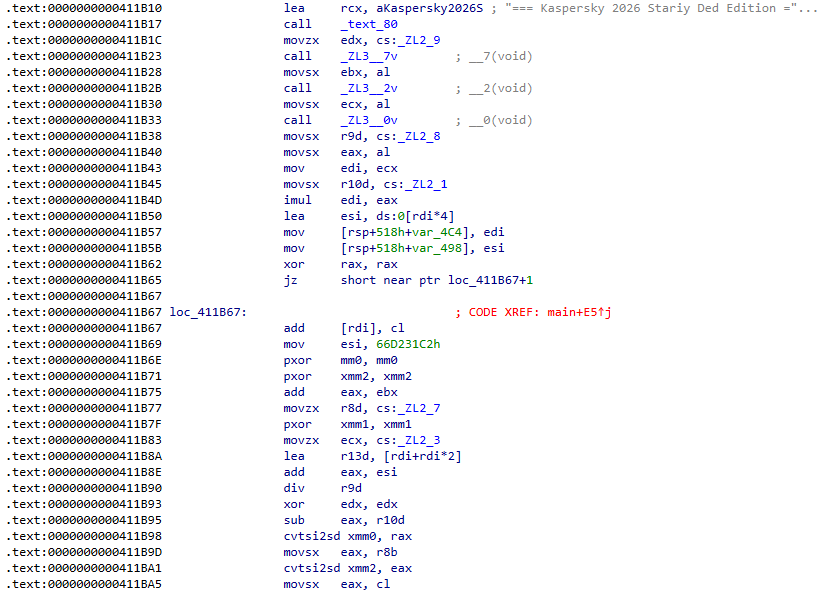
- employing identical code obfuscation.
An example of GentleKiller’s output is illustrated in Figure 1, and a code snippet showing the code obfuscation is depicted in Figure 2.
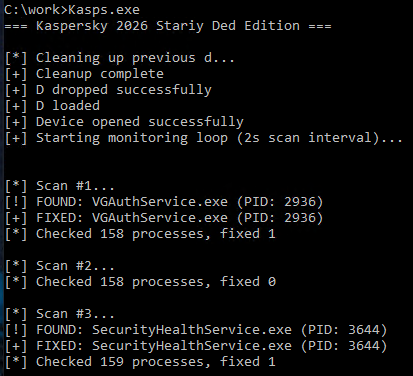
This design prioritizes ease of deployment and operational flexibility for affiliates, while minimizing development effort for the operators. It allows the Gentlemen operators to integrate abused drivers into their toolset very soon after an EDR killer PoC is disclosed. This was the case with UnknownKiller and PoisonKiller, which were adopted within a matter of days.
While some builds don’t target all the processes known to GentleKiller, the general set, provided in Table 2, is consistent. We leveraged AI to map the process names to their corresponding vendors, and acknowledge that there might be minor inconsistencies. Overall, GentleKiller targets more than 400 processes that the AI mapped to 48 products.
Table 2. A complete list of process names targeted by GentleKiller, mapped to their corresponding vendors
| Vendor | Targeted processes |
| Acronis | acronis_agent.exe, BackupAndRecoveryAgent.exe, managementagenthost.exe, mms.exe |
| AlienVault | alienvault-agent.exe, osqueryd.exe |
| Avast | afwServ.exe, aswEngSrv.exe, aswidsagent.exe, aswToolsSvc.exe, AvastSvc.exe, AvastUI.exe, avastsvc.exe, avastui.exe, bccavsvc.exe, wsc_proxy.exe |
| AVG | AVGUI.exe, AVGSvc.exe, avgnt.exe, avgsvca.exe, avgToolsSvc.exe |
| Binary Defense | BinaryDefenseAgent.exe |
| Bitdefender | Arrakis3.exe, BDAvScanner.exe, BDFsTray.exe, BDFileServer.exe, BDLived2.exe, BDLogger.exe, BDScheduler.exe, BDStatistics.exe, bdagent.exe, bdemsrv.exe, bdntwrk.exe, bdredline.exe, bdregsvr2.exe, bdservicehost.exe |
| Blumira | BlumiraAgent.exe |
| Bromium | BromiumDaemon.exe, BrDifxapi.exe |
| Carbon Black | cb.exe, cbcomms.exe, cbdefense.exe, carbonsensor.exe, RepMgr.exe |
| Cisco Talos | cfrutil.exe, CiscoAMPCEFWDriver.exe, cisco_amp_connector.exe, immunet.exe |
| CrowdStrike | ARWSRVC.EXE, ARCUpdate.exe, CSFalconContainer.exe, CSFalconService.exe, CSFalconUI.exe, csfalcondataprotect.exe, csfalcondaterepair.exe, REPRSVC.EXE |
| Cynet | CynetEPS.exe, CynetMS.exe, CynetSvc.exe |
| Cybereason | ActiveConsole.exe, cybereason.exe, CybereasonActiveProbe.exe, CybereasonCR.exe |
| Cyvera | CyveraConsole.exe, CyveraService.exe, CyvrAgentSvc.exe, CyvrFsFlt.exe, cyvrfsflt.exe |
| Cylance/BlackBerry | CylanceSvc.exe |
| Darktrace | DarktraceTSA.exe |
| Deep Instinct | DeepInstinct.exe, DeepInstinctService.exe, DIAgentService.exe |
| Elastic | a2guard.exe, a2service.exe |
| ESET | eamonm.exe, eamsi.exe, ecls.exe, efwd.exe, egui.exe, eguiProxy.exe, ekrn.exe, ekrnEpfw.exe, ERAAgent.exe, EraAgentSvc.exe |
| Fortinet | firesvc.exe, firetray.exe, FortiTray.exe, fortiedr.exe, fw.exe |
| G DATA | GDDServer.exe, QHPISVR.EXE, QUHLPSVC.EXE, SAPISSVC.EXE |
| Heimdal | HeimdalsecurityAgent.exe |
| Huntress | HuntressAgent.exe, HuntressRMM.exe |
| Kaspersky | avp.exe, avpsus.exe, avpui.exe, kavfs.exe, kavfsscs.exe, kavfswh.exe, kavfswp.exe, kavtray.exe, klactprx.exe, klcsldcl.exe, klcsweb.exe, klnagent.exe, klnagchk.exe, klscctl.exe, klserver.exe, klwtblfs.exe, kpf4ss.exe, ksde.exe, ksdeui.exe, vapm.exe |
| LogRhythm | LogProcessorService.exe |
| McAfee/Trellix | AGMService.exe, AGSService.exe, masvc.exe, macmnsvc.exe, McAfeeAgent.exe, mcshield.exe, mfeann.exe, mfevtps.exe, mfetp.exe, mfeepehost.exe, mfefire.exe, mfemactl.exe, mfemacsvc.exe, mfemgr.exe, mfemms.exe, MgntSvc.exe, ModuleCoreService.exe, tepfsvc.exe |
| Microsoft Defender | MSASCui.exe, MSASCuiL.exe, MpDefenderCoreService.exe, MsMpEng.exe, MsMpSvc.exe, MsSense.exe, msascuil.exe, msseces.exe, NisSrv.exe, nissrv.exe, SecurityHealthService.exe, SecurityHealthSystray.exe, SenseCncProxy.exe, SenseIR.exe, SenseNdr.exe, SenseSampleUploader.exe, smartscreen.exe, windefend.exe |
| Morphisec | MorphisecService.exe |
| Norton/Symantec | ccApp.exe, ccSvcHst.exe, ccsvchst.exe, ns.exe, nsservice.exe, nortonsecurity.exe, rtvscan.exe, SepMasterService.exe, sepWscSvc64.exe, smc.exe, SmcGui.exe, snac.exe, SymCorpUI.exe, SymWSC.exe |
| OSSEC/Wazuh | ossec-agent.exe, wazuh-agent.exe |
| Palo Alto Networks (Traps/Cortex) | cortexService.exe, trapsagent.exe, trapsd.exe, Traps.exe |
| Panda Security | panda_url_filtering.exe, pavfnsvr.exe, pavsrv.exe, psanhost.exe, PSANHost.EXE, pselamsvc.EXE, PSUAMain.EXE, PSUAService.EXE, pangps.exe |
| Qualys | qualys-cloud-agent.exe, QualysAgent.exe |
| Rapid7 | ir_agent.exe, rapid7_endpoint.exe |
| Red Canary | RedCanaryAgent.exe |
| Sangfor | CSAAgent.exe, CSAService.exe, SangforAgent.exe, SangforCSA.exe, SangforEDR.exe, SangforInterface.exe, SangforMonitor.exe, SangforProtect.exe, SangforService.exe, SangforTray.exe, SangforUD.exe |
| SentinelOne | Sentinel.exe, SentinelAgent.exe, SentinelAgentWorker.exe, SentinelCtl.exe, SentinelHelperService.exe, SentinelMemoryScanner.exe, SentinelPowerShellExtension.exe, SentinelRanger.exe, SentinelServiceHost.exe, SentinelStaticEngine.exe, SentinelStaticEngineScanner.exe, SentinelUI.exe |
| SonicWall | SonicWallClientProtectionService.exe, swc_service.exe |
| Sophos | hmpalert.exe, McsAgent.exe, McsClient.exe, SavApi.exe, SAVAdminService.exe, SAVService.exe, SEDService.exe, SophosADSyncService.exe, SophosClean.exe, SophosCleanM64.exe, SophosFIMService.exe, SophosFS.exe, SophosHealth.exe, SophosLiveQueryService.exe, SophosMTR.exe, SophosMTRExtension.exe, SophosNetFilter.exe, SophosNtpService.exe, SophosOsquery.exe, SophosOsqueryExtension.exe, Sophos.PolicyEvaluation.Service.exe, SophosSafestore64.exe, SophosUI.exe, SophosUpdateMgr.exe, sophosav.exe, sophossps.exe, SSPService.exe |
| Tanium | TaniumClient.exe, TaniumCX.exe, tanclient.exe |
| ThreatLocker | ThreatLockerConsent.exe, threatlockerservice.exe, threatlockertray.exe |
| TrendAI | coreFrameworkHost.exe, coreServiceShell.exe, NTRTScan.exe, ntrtscan.exe, Ntrtscan.exe, OfcService.exe, ofcDdaSvr.exe, PccNTMon.exe, PccNt.exe, TISafe.exe, TISafeSvc.exe, TmCCSF.exe, tmicAgentSetting.exe, TMBMSRV.exe, Tmbmsrv.exe, tm_netsrv.exe, TmListen.exe, tmntsrv.exe, TmPfw.exe, tmproxy.exe, TmProxy.exe, TmPreFilter.exe, TmSSClient.exe, TmsaInstance64.exe, TmWscSvc.exe, VOneAgentConsole.exe, VOneAgentConsoleTray.exe |
| Uptycs | VectorAgent.exe, UptycsAgent.exe |
| Varonis | DatAdvantage.exe, VaronisAgent.exe |
| WatchGuard | wlcsservice.exe |
| Webroot | WRSA.exe, WRSkyClient.exe, WRSVC.exe, wrsa.exe |
| Windows Sysinternals | Sysmon.exe, Sysmon64.exe |
| Zscaler | zlclient.exe |
GentleKiller variants
Each GentleKiller variant impersonates a different product and abuses a different malicious or vulnerable driver. Table 3 provides a list of the eight GentleKiller variants we have observed so far. The <suffix> refers to the naming pattern explained in Table 1. Drivers’ filenames refer to how GentleKiller drops them to disk.
Table 3. List of GentleKiller variants
| Variant name | Filenames | Abused driver |
| Kaspersky | Kasp<suffix>.exe | eb.sys, a rootkit (PoC) |
| FACEIT Anti-Cheat | FaceIT<suffix>.exe | nseckrnl.sys, NSecsoft NSecKrnl driver (PoC) |
| Valorant | Valorant<suffix>.exe | GameDriverX64.sys, an anti-cheat driver (PoC) |
| Javelin | EAAntiCheat<suffix>.exe EASolo<suffix>.exe |
stpm_(old|new).sys, two vulnerable ProcessMonitor Driver samples by Safetica (PoC) |
| WatchDog | BitD<suffix>.exe | dmx.sys, Zemana’s WatchDog Antimalware Driver (PoC) |
| Network Blocker | MB<suffix>.exe | 360netmon_wfp.sys, a vulnerable driver by Qihoo 360 Technology (PoC) |
| Cleaner | Deletor.exe | IMFForceDelete, IObit’s IMF ForceDelete filter driver (PoC); the driver is dropped without the trailing .sys extension |
| G11 | G11<suffix>.exe Symantec<suffix>.exe |
PoisonX, a rootkit (PoC) |
Third-party EDR killers
Apart from the internally developed GentleKiller, Gentlemen has incorporated multiple third-party solutions into its suite, summarized in Table 4 and described in the following sections. The <suffix> refers to the naming pattern explained in Table 1. Driver filenames refer to how the associated EDR killers drop them to disk.
Table 4. List of third-party EDR killers offered by Gentlemen
| ESET name for the EDR killer | Filenames | Abused driver |
| HexKiller | Avast<suffix>.exe | googleApiUtil64.sys, Baidu Antivirus BdApi driver |
| ThrottleBlood | Sent<suffix>.exe | ThrottleBlood.sys, driver by TechPowerUp LLC |
| HavocKiller | HwAudKiller.exe Sophos<suffix>.exe |
havoc.sys, Huawei Audio driver |
HexKiller
HexKiller is an EDR killer that we previously assessed as being exclusive to the Warlock gang. Therefore, its appearance within Gentlemen intrusions is unexpected and noteworthy.
We found HexKiller staged alongside GentleKiller binaries within the GentlemenCollection directory. Nevertheless, its presence in Gentlemen intrusions does not, by itself, imply direct collaboration or operational overlap between the Gentlemen and Warlock gangs. It is plausible that Gentlemen operators obtained HexKiller through indirect means, such as private exchanges, secondary distribution channels, or sample leaks, without any need for direct interaction with Warlock. We therefore don’t consider this to be evidence of a deeper relationship between the two groups.
ThrottleBlood
This EDR killer has been repeatedly observed in intrusions carried out by MedusaLocker affiliates, and, less frequently, by DragonForce affiliates. Additionally, it was linked to Gentlemen by Trend Micro in September 2025.
At present, we do not have sufficient evidence to conclusively determine the origin of ThrottleBlood. In our telemetry, it appears prominently deployed across multiple MedusaLocker intrusions and sporadically in DragonForce-related activity. These incidents show little operational overlap beyond the use of ThrottleBlood itself. One possible explanation is that ThrottleBlood is commercially distributed on underground markets, or alternatively a tool developed by MedusaLocker operators and shared with their affiliates, some of whom may also have ties to DragonForce.
Neither hypothesis, however, fully explains how a ThrottleBlood sample appeared in Gentlemen’s possession. As a result, we cannot rule out the possibility of Gentlemen acquiring the tool through it leaking beyond the originally intended context. What we state with high confidence, however, is that Gentlemen did not develop this EDR killer in-house.
HavocKiller
HavocKiller is the final addition to Gentlemen’s EDR-killer arsenal. While the tool was publicly disclosed by Huntress on March 19th, 2026, ESET telemetry confirms its use in real-world intrusions dating back to at least January 23rd, 2026, indicating that it had been operational for weeks prior to public reporting. We can also corroborate Huntress’s assessment regarding its purpose: in all cases observed by ESET, the deployment of HavocKiller was part of ransomware-related activity.
Based on its technical characteristics, we assess that HavocKiller is not developed by the Gentlemen operators themselves, but instead was obtained through external means. Although the samples were staged within the GentlemenCollection directory and Gentlemen’s standard set of defense evasion techniques was applied to them, the underlying implementation differs substantially from GentleKiller. This strongly suggests that HavocKiller represents a third-party EDR killer that was adapted operationally, but its architecture does not fit into Gentlemen’s framework.
OxideHarvest
We also detected several deployments of a tool we named OxideHarvest, a credential stealer written in Rust. Since Rust is not the programming language of choice for Gentlemen, we do not attribute the tool to the group. However, as Check Point noted, a Gentlemen affiliate named quant maintains a tool referred to as buildx641, whose naming and functionality immediately reminded us of OxideHarvest. Indeed, after further investigation, we found an OxideHarvest sample named buildx641.exe uploaded to VirusTotal; we conclude that buildx641 and OxideHarvest are the same tool.
OxideHarvest comes wrapped inside different packers, often mimicking legitimate software in version information and icon (similar, but not identical, to what Gentlemen does with GentleKiller). The protected payload is a simple, straightforward credential stealer. To function, OxideHarvest requires the user to specify the list of hosts (-i), username (-u), password (-p), number of threads (-t), and an output file (-o) as command line options. The tool then uses the supplied credentials to log into the specified hosts (passed as a newline-delimited text file), employs multithreading, and exfiltrates credentials into the supplied output file. Figure 9 shows the result of the --help command of OxideHarvest, and Table 5 shows its configuration dictating which credentials are targeted.
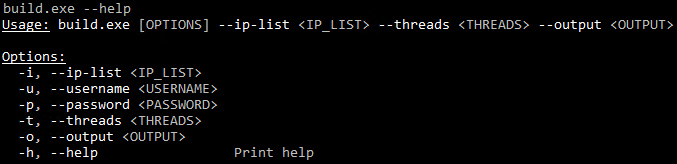
Table 5. Embedded configuration of OxideHarvest
{
    "chronium_browsers": [
        [
            "Google Chrome",
            "\\Google\\Chrome\\User Data",
            true
        ],
        [
            "Google Chrome Beta",
            "\\Google\\Chrome Beta\\User Data",
            true
        ],
        [
            "ChromeBeta",
            "\\Google\\Chrome SxS\\User Data",
            true
        ],
        [
            "Chromium",
            "\\Chromium\\User Data",
            true
        ],
        [
            "Microsoft Edge",
            "\\Microsoft\\Edge\\User Data",
            true
        ],
        [
            "Torch",
            "\\Torch\\User Data",
            true
        ],
        [
            "Comodo",
            "\\Comodo\\Dragon\\User Data",
            true
        ],
        [
            "Nichrome",
            "\\Nichrome\\User Data",
            true
        ],
        [
            "Maxthon5",
            "\\Maxthon5\\Users",
            true
        ],
        [
            "Epic Privacy Browser",
            "\\Epic Privacy Browser\\User Data",
            true
        ],
        [
            "Vivaldi",
            "\\Vivaldi\\User Data",
            true
        ],
        [
            "QIP",
            "\\QIP Surf\\User Data",
            true
        ],
        [
            "Cent",
            "\\CentBrowser\\User Data",
            true
        ],
        [
            "Elements",
            "\\Elements Browser\\User Data",
            true
        ],
        [
            "TorBro",
            "\\TorBro\\Profile",
            true
        ],
        [
            "CryptoTab",
            "\\CryptoTab Browser\\User Data",
            true
        ],
        [
            "Brave",
            "\\BraveSoftware\\Brave-Browser\\User Data",
            true
        ],
        [
            "Opera",
            "\\Opera Software\\Opera Stable\\",
            false
        ],
        [
            "OperaGX",
            "\\Opera Software\\Opera GX Stable\\",
            false
        ],
        [
            "Opera Neon",
            "\\Opera Software\\Opera Neon\\User Data",
            false
        ]
    ],
    "gecko_browsers": [
        [
            "Mozila Firefox",
            "\\Mozilla\\Firefox\\Profiles\\",
            false
        ],
        [
            "Slim",
            "\\FlashPeak\\SlimBrowser\\Profiles\\",
            false
        ],
        [
            "PaleMoon",
            "\\Moonchild Productions\\Pale Moon\\Profiles\\",
            false
        ],
        [
            "Waterfox",
            "\\Waterfox\\Profiles\\",
            false
        ],
        [
            "Cyberfox",
            "\\8pecxstudios\\Cyberfox\\Profiles\\",
            false
        ],
        [
            "BlackHawk",
            "\\NETGATE Technologies\\BlackHawk\\Profiles\\",
            false
        ],
        [
            "IceCat",
            "\\Mozilla\\icecat\\Profiles\\",
            false
        ],
        [
            "KMeleon",
            "\\K-Meleon\\",
            false
        ]
    ]
}
Conclusion
Gentlemen demonstrates an interesting approach: operator-managed EDR killers, ready to use by affiliates. While most ransomware gangs continue to delegate EDR killing to affiliates, Gentlemen has chosen to centralize this function by offering affiliates a ready-to-use, standardized EDR-killer suite. This decision makes Gentlemen an attractive operator for affiliates as it materially lowers the entry barrier for them, making their job consequently easier.
This model differs even from the few known exceptions in the ecosystem. In the case of RansomHub, the operators invested in a single EDR killer, EDRKillShifter, developed entirely in-house. Gentlemen, by contrast, maintains a diverse portfolio of EDR killers, blending original development (GentleKiller) with rapidly adapted third-party or publicly disclosed tooling (HexKiller, ThrottleBlood, and HavocKiller). The consistent application of defense evasion techniques across these tools further obscures and complicates straightforward attribution when samples are observed in isolation.
Because EDR-killer techniques continue to commoditize and circulate across underground communities, this blogpost underscores the necessity of incident-level investigation and analysis. Without such context, Gentlemen’s EDR killers are likely to be misattributed, or not attributed at all, masking the true extent of this operator’s involvement. Thanks to our continuous insight into Gentlemen intrusions, we were able to provide protection against the group’s attacks months before the recently leaked data confirmed our high-confidence hypotheses on the gang’s EDR-killer suite.
The GentleKiller framework illustrates a deliberate balance between in-house development and pragmatic reuse of external research. While some components show signs of rushed implementation or inconsistent polish, the overall toolset demonstrates high operational effectiveness and tight integration into Gentlemen’s ransomware workflow. The group’s ability to adapt newly published BYOVD PoCs within days further underscores its agility.
From a defense perspective, understanding how GentleKiller works allows defenders to better design their defensive strategies and defend even against yet-to-be-developed, new additions to Gentlemen’s EDR-killing arsenal.
For any inquiries about our research published on WeLiveSecurity, please contact us at threatintel@eset.com.ESET Research offers private APT intelligence reports and data feeds. For any inquiries about this service, visit the ESET Threat Intelligence page.
IoCs
Files
| SHA-1 | Filename | Detection | Description |
| 8AE6BD18B129061F6364 |
Kasps.exe | Win64/KillAV.EA | GentleKiller (Kaspersky variant). |
| BA914FE77B177B457994 |
eb.sys | Win64/Agent.ITG | A custom rootkit used by the Kaspersky variant of GentleKiller. |
| D605994FC72A2BB59B5C |
FaceIT1.exe | Win64/KillAV.EA | GentleKiller (FACEIT Anti-Cheat variant, Enigma-protected). |
| B0B912A3FD1C05D72080 |
nseckrnl.sys | Win64/VulnDriver |
NSecsoft NSecKrnl driver abused by the FACEIT Anti-Cheat variant of GentleKiller. |
| 5AA3124E5C4921E5EDFC |
Valorant2.exe | Win64/KillAV.EA | GentleKiller (Valorant variant, Themida-protected). |
| 7556AE58C215B8245A43 |
vgk.sys | Win64/VulnDriver |
Tower of Fantasy AntiCheat driver abused by the Valorant variant of GentleKiller. |
| 331879F5EEC8892BBD89 |
EASolo2Light.exe | Win64/KillAV.EA | GentleKiller (Javelin variant abusing Safetica’s newer driver). |
| F11AEBCCB9A86A7E2E65 |
EASOLO1clear.exe | Win64/KillAV.EA | GentleKiller (Javelin variant abusing Safetica’s older driver). |
| EF9CD06683159397F099 |
EAAntiCheatLight |
Win64/KillAV.EA | GentleKiller (Javelin variant abusing both drivers). |
| 711EF221526997039E80 |
stpm_old.sys | Win64/VulnDrive |
Safetica’s Process Monitor Driver (older) abused by the Javelin variant of GentleKiller. |
| 68FEC379F2AE76C3D2CE |
stpm_new.sys | Win64/VulnDrive |
Safetica’s Process Monitor Driver (newer) abused by the Javelin variant of GentleKiller. |
| A11EE9CDC59E5CAA59AE |
BitD1.exe | Win64/KillAV.EA | GentleKiller (WatchDog variant, Themida-protected). |
| 96F0DBF52AED0AFD43E4 |
dmx.sys | Win64/VulnDrive |
Zemana’s WatchDog Antimalware Driver abused by the WatchDog variant of GentleKiller. |
| 2F86898528C6CAB3540C |
MB2.exe | Win64/KillAV.EA | GentleKiller (Network Blocker variant, Themida-protected). |
| 9AD51AD97C01E97AB592 |
360netmon_wfp.sys | Win64/VulnDrive |
360netmon.sys driver abused by the Network Blocker variant of GentleKiller. |
| A19117175DBC9BA4D23B |
Deletor.exe | Win64/KillAV.EA | GentleKiller (Cleaner variant). |
| 12500F6C87CE62712A0E |
IMFForceDelete | Win64/VulnDrive |
IMF ForceDelete filter driver abused by the Cleaner variant of GentleKiller. |
| D29670E684E40DDC89B4 |
Symantec.exe | Win64/KillAV.EA | GentleKiller (G11 variant). |
| 56BEE9DF5833A637F5C5 |
G11.sys | Win64/Agent.IYQ | PoisonX rootkit used by the G11 variant of GentleKiller. |
| CF4D74DF17A91B4A36A2 |
Avast.exe | Win32/KillAV.NVL | HexKiller incorporated into Gentlemen modus operandi by adding the evasion layer. |
| EC296F9501AD71E43081 |
googleApiUtil64 |
Win64/VulnDrive |
Baidu Antivirus BdApi driver abused by HexKiller. |
| 7131B377E96016DC1911 |
Sent.exe | Win64/KillAV.AT | ThrottleBlood incorporated into Gentlemen modus operandi by adding the evasion layer. |
| 82ED942A52CDCF120A89 |
ThrottleBlood.sys | Win64/VulnDrive |
ThrottleStop.sys driver abused by ThrottleBlood. |
| F0537CBB773AE12100B3 |
Sophos.exe | Win64/KillAV.DE | HavocKiller incorporated into Gentlemen modus operandi by adding the evasion layer. |
| 1FA071303FB846308571 |
havoc.sys | Win64/VulnDrive |
Vulnerable driver abused by HavocKiller. |
| A5CF917EC4A7DFBDFA43 |
buildx641.exe | Win64/Spy.Agent.AGC | OxideHarvest. |
| D4B19141102015D43632 |
buildx64.exe | Win64/Spy.Agent.AGC | OxideHarvest. |
MITRE ATT&CK techniques
This table was built using version 19 of the MITRE ATT&CK framework.
| Tactic | ID | Name | Description |
| Execution | T1059.003 | Command and Scripting Interpreter: Windows Command Shell | GentleKiller and related tools are console-based executables that run visibly and emit debug strings during execution. |
| T1106 | Native API | User-mode components interact directly with kernel drivers via DeviceIoControl and other native Windows APIs to perform privileged actions. | |
| Persistence | T1543.003 | Create or Modify System Process: Windows Service | The EDR killers install and start vulnerable or malicious drivers as services prior to exploitation. |
| Stealth | T1036 | Masquerading | Gentlemen’s EDR killers are protected by impersonating legitimate vendors through filenames, version information, icons, and copied digital certificates. |
| T1036.001 | Masquerading: Invalid Code Signature | The protection applied to Gentlemen’s EDR killers adds an invalid code signature as part of the impersonation strategy. | |
| T1027 | Obfuscated Files or Information | Some executables are protected with packers (e.g., Enigma, Themida) and custom control-flow obfuscation. | |
| Defense Impairment | T1685 | Disable or Modify Tools | GentleKiller and other EDR killers that Gentlemen is in possession of aim to bypass security products such as EDRs. |