
Many of us still view cryptocurrency as a niche asset. Yet some estimates claim that nearly one in 10 people globally own some. That’s why you may have noticed Bitcoin or crypto ATMs springing up in retail stores, transport hubs, and gas stations over recent years. Today there are tens of thousands in the US alone.
Their job is simple: allow you to buy or sell crypto using cash or card. But scammers also have them in their sights. If you ever receive an unsolicited call urging you to deposit money into a crypto ATM, hang up immediately, no matter how serious the allegations. No real government agency, bank, or company will ever tell you to pay them via a Bitcoin ATM.
How do Bitcoin ATM scams work?
According to the FBI, 13,460 of these scams made fraudsters $389 million in 2025, a 23% increase in volume and 58% in losses over 2024. Most of those complaints came from people over 50, who lost more than $302m between them. Victims over 60 accounted for $257.4m of that total.
Older victims are over-represented partly because fewer of them know what crypto ATMs are. But the machine is only the payment method. What makes the scam work is a phone call designed to frighten you and keep you on the line.
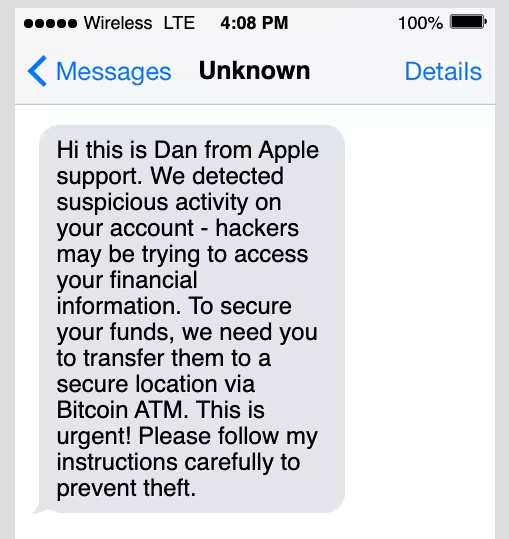
The scam itself is a variation of an “impersonation” attack. That is, you will usually be called up out of the blue by a fraudster masquerading as a serious-sounding police officer, government employee or other trusted official. Or you might get a popup on your computer telling you to call a number as your machine is infected. Once you’re on the phone, they will try to:
- Frighten you by saying someone has accessed your bank account, or your identity or account is being used for criminal activity. They may alternatively confirm that your computer is infected.
- Tell you that your funds are at risk and that you need to move them somewhere ‘safe’.
- Keep you on the phone and discourage you from seeking help from friends, family or legitimate authorities.
- Tell you to withdraw your cash from your bank.
- Direct you to a specific Bitcoin/crypto ATM, and tell you to deposit the cash and purchase Bitcoin/crypto with it.
- Text you a QR code to scan. In fact, the QR code tells the ATM to send those funds to a crypto account under the criminal’s control. Because it’s crypto, it can be extremely difficult to reverse the transaction.
Can I get my money back from a crypto ATM scam?
Crypto ATMs are deliberately used by cybercriminals precisely because the funds are not like card transactions: they’re very difficult to reverse and there’s no chargeback facility. Although transaction flows can be traced, wallet holders are able to stay anonymous. All of which makes it very unlikely that you’ll get your money back.
How do I stay safe from Bitcoin ATM scams?
Steer clear of these scams in the first place by spotting the warning signs. If someone calls you up purporting to be an official, slow them down, get their details, and put the phone down. Don’t fall for their attempts to frighten you and create a sense of urgency.
Then call a friend or family member to sanity check the story you’ve just been told. Or verify it by contacting the organization or individual directly. But always use official contact information rather than a number/email address given to you by the caller.
Likewise, never respond to unsolicited emails, messages or computer popups by calling the number provided. Always check via official channels only. If you're already standing at the machine with a caller in your ear, end the call and walk away.
It goes without saying that you should never take large sums of money out of your bank account and deposit them in a crypto ATM at the request of a stranger who calls you on the phone. Real businesses, government agencies, and law enforcers will never request that you do so.
What can I do straight after a Bitcoin ATM scam?
If you’re in the middle of being scammed or the worst has already happened, follow these steps immediately:
- Stop communicating with the scammers. Don’t reply to their messages and hang up
- Save any evidence you might have including ATM receipts, texts, emails, call logs, and bank transactions
- Find out the contact details of the ATM operator (which are usually found on the receipt or the machine itself) and tell them immediately what has just happened
- Contact your bank to tell them what happened and ensure your accounts are safe
- In the US, report to your local police, and the FTC as well as the FBI’s IC3
The chances of recovery are extremely low. But that doesn’t mean you shouldn’t report what just happened. Reporting is important to help the authorities better understand fraud patterns and provide the best preventative advice to the populace.
You should also be on the lookout for recovery scams, where the same or other groups of fraudsters will call you up pretending to be able to get your funds back for a fee. They can’t, and they will simply make off with more of your money.
Frequently asked questions (FAQs)
Can a Bitcoin ATM transaction be reversed?
No, your money usually can’t be reversed as if it were a card payment. The Bitcoin ATM operator doesn’t hold the funds and can’t reverse the transaction. Once it’s gone, it’s gone.
Would police or government officials ever investigate Bitcoin ATM fraud?
Usually not. They will log your report so you have an official record of the crime if needed. But in most cases, it will not be investigated.
Why do scammers demand Bitcoin ATM transfers?
It’s harder for the authorities to trace than wire fraud and there’s no chargeback mechanism for victims to get their funds back. It’s also fast and anonymous, while social engineering tricks play on our anxieties and predispose us to believing what we’re being told over the phone.
What should I do if I’ve fallen for a Bitcoin ATM scam?
Stop communicating with the scammers. Save any evidence you might have including ATM receipts, texts, emails, call logs, and bank transactions. Find out the contact details of the ATM operator and your bank and tell them immediately what has just happened. In the US, report to your local police, the FTC and the FBI’s IC3.
Someone says they can get my money back after a Bitcoin ATM scam. Is this for real?
Unfortunately not. They’re likely to be a “recovery scammer,” preying on victims of these scams. They’ll ask you for an admin fee or similar which they’ll simply take without getting your money back.